Ch.19 - Free Energy & Thermodynamics
Tro - Chemistry: A Molecular Approach 6th Edition
Tro6th EditionChemistry: A Molecular ApproachISBN: 9780137832217당신이 사용하는 게 아니라요?교과서 변경
19장, 문제 58a

Use data from Appendix IIB to calculate ΔS°rxn for each of the reactions. In each case, try to rationalize the sign of ΔS°rxn . a. 3 NO2(g) + H2O(l) → 2 HNO3(aq) + NO(g)

검증된 단계별 안내
1
Identify the substances involved in the reaction: 3 NO_2(g) + H_2O(l) → 2 HNO_3(aq) + NO(g).
Use Appendix IIB to find the standard molar entropy (S°) values for each substance: NO_2(g), H_2O(l), HNO_3(aq), and NO(g).
Calculate the total standard entropy of the reactants by summing the products of the stoichiometric coefficients and their respective S° values: (3 * S°(NO_2) + 1 * S°(H_2O)).
Calculate the total standard entropy of the products in a similar manner: (2 * S°(HNO_3) + 1 * S°(NO)).
Determine the standard entropy change for the reaction (ΔS°_rxn) by subtracting the total entropy of the reactants from the total entropy of the products: ΔS°_rxn = (Total S° of products) - (Total S° of reactants).

비슷한 문제에 대한 검증된 영상 답변:

이 영상 해법은 위 문제에 도움이 된다고 튜터들이 추천한 것입니다.
영상 길이:
2m

주요 개념

질문에 올바르게 답하기 위해 반드시 이해해야 하는 핵심 개념들은 다음과 같습니다.

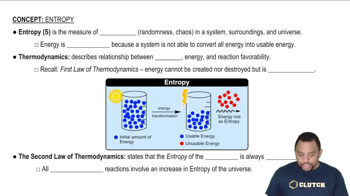
Entropy (ΔS)

Entropy is a measure of the disorder or randomness in a system. In chemical reactions, changes in entropy (ΔS) indicate how the distribution of energy and matter changes as reactants transform into products. A positive ΔS suggests an increase in disorder, while a negative ΔS indicates a decrease in disorder.
추천 영상:
가이드 코스
02:46
Entropy in Thermodynamics

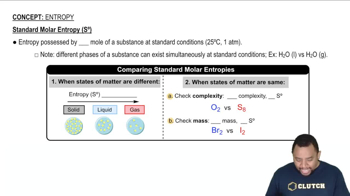
Standard Entropy Values

Standard entropy values (S°) are tabulated values that represent the absolute entropy of a substance at standard conditions (1 atm and 25°C). These values are essential for calculating the change in entropy for a reaction (ΔS°rxn) by using the formula ΔS°rxn = ΣS°products - ΣS°reactants, where the sum is taken over all products and reactants.
추천 영상:
가이드 코스
03:33
Standard Molar Entropy

Rationalizing ΔS°rxn Sign

Rationalizing the sign of ΔS°rxn involves analyzing the physical states and the number of moles of reactants and products. Generally, reactions that produce more gas molecules than they consume tend to have a positive ΔS, while those that produce fewer gas molecules or involve a transition from gas to liquid or solid typically have a negative ΔS. Understanding these trends helps predict the entropy change in a reaction.
추천 영상:
가이드 코스
03:38
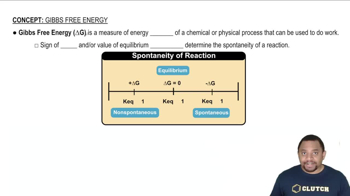
Spontaneity of Reactions