Ch.2 - Atoms & Elements
Tro - Chemistry: A Molecular Approach 6th Edition
Tro6th EditionChemistry: A Molecular ApproachISBN: 9780137832217당신이 사용하는 게 아니라요?교과서 변경
2장, 문제 94a

What is the mass, in grams, of each elemental sample? a. 0.0133 mol Xe

검증된 단계별 안내
1
Identify the molar mass of xenon (Xe) from the periodic table. The molar mass of Xe is approximately 131.29 g/mol.
Use the formula: \( \text{mass} = \text{moles} \times \text{molar mass} \).
Substitute the given number of moles (0.0133 mol) and the molar mass of Xe (131.29 g/mol) into the formula.
Calculate the product to find the mass in grams.
Ensure the units are consistent and the final answer is in grams.

비슷한 문제에 대한 검증된 영상 답변:

이 영상 해법은 위 문제에 도움이 된다고 튜터들이 추천한 것입니다.
영상 길이:
48s
도움이 되었나요?

주요 개념

질문에 올바르게 답하기 위해 반드시 이해해야 하는 핵심 개념들은 다음과 같습니다.

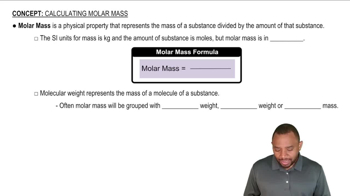
Molar Mass

Molar mass is the mass of one mole of a substance, typically expressed in grams per mole (g/mol). It is calculated by summing the atomic masses of all the atoms in a molecule. For example, xenon (Xe) has a molar mass of approximately 131.29 g/mol, which is essential for converting moles to grams.
추천 영상:
가이드 코스
02:11
Molar Mass Concept

Conversion from Moles to Grams

To find the mass of a substance in grams from its amount in moles, you multiply the number of moles by the molar mass of the substance. The formula is: mass (g) = moles × molar mass (g/mol). This conversion is fundamental in stoichiometry and helps in quantifying reactants and products in chemical reactions.
추천 영상:
가이드 코스
02:28
Mass and Moles Conversion

Stoichiometry

Stoichiometry is the branch of chemistry that deals with the quantitative relationships between the amounts of reactants and products in a chemical reaction. It allows chemists to predict how much of each substance is needed or produced, based on balanced chemical equations. Understanding stoichiometry is crucial for solving problems involving moles and mass.
추천 영상:
가이드 코스
01:16
Stoichiometry Concept