Ch.20 - Electrochemistry
Tro - Chemistry: A Molecular Approach 6th Edition
Tro6th EditionChemistry: A Molecular ApproachISBN: 9780137832217당신이 사용하는 게 아니라요?교과서 변경
20장, 문제 61a

Determine whether or not each metal dissolves in 1 M HCl. For those metals that do dissolve, write a balanced redox reaction showing what happens when the metal dissolves. a. Cu

검증된 단계별 안내
1
Identify the reactivity of copper (Cu) with hydrochloric acid (HCl). Copper is less reactive than hydrogen and does not dissolve in HCl.
Understand that for a metal to dissolve in HCl, it must be able to displace hydrogen from the acid, forming hydrogen gas and a metal chloride.
Consult the activity series of metals, which ranks metals by their ability to displace hydrogen from acids. Copper is below hydrogen in the activity series.
Since copper is below hydrogen in the activity series, it does not react with 1 M HCl to produce hydrogen gas.
Conclude that copper does not dissolve in 1 M HCl, and therefore, no redox reaction occurs.

비슷한 문제에 대한 검증된 영상 답변:

이 영상 해법은 위 문제에 도움이 된다고 튜터들이 추천한 것입니다.
영상 길이:
3m
도움이 되었나요?

주요 개념

질문에 올바르게 답하기 위해 반드시 이해해야 하는 핵심 개념들은 다음과 같습니다.

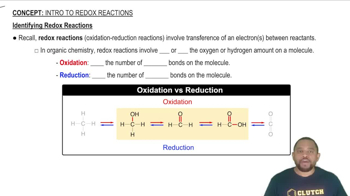
Redox Reactions

Redox reactions involve the transfer of electrons between two species, leading to changes in oxidation states. In these reactions, one species is oxidized (loses electrons) while another is reduced (gains electrons). Understanding redox processes is crucial for predicting how metals will react with acids, such as HCl, and determining the products formed.
추천 영상:
가이드 코스
03:12
Identifying Redox Reactions

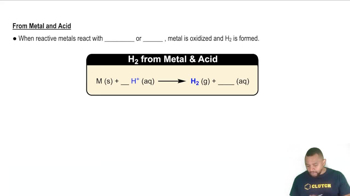
Metal Reactivity with Acids

The reactivity of metals with acids is determined by their position in the reactivity series. More reactive metals, like zinc and magnesium, readily dissolve in acids, displacing hydrogen ions and forming metal ions. In contrast, less reactive metals, such as copper, do not react significantly with dilute acids, which is essential for predicting whether a metal will dissolve in HCl.
추천 영상:
가이드 코스
00:52
From Metal and Acid

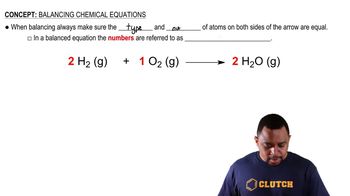
Balanced Chemical Equations

A balanced chemical equation represents a chemical reaction with equal numbers of each type of atom on both sides of the equation. Balancing is essential for accurately depicting the stoichiometry of the reaction, including the reactants and products. In the context of metal dissolution in HCl, writing a balanced equation helps illustrate the transformation of the metal and the generation of hydrogen gas.
추천 영상:
가이드 코스
01:32
Balancing Chemical Equations