
A Cu/Cu2+ concentration cell has a voltage of 0.22 V at 25 °C. The concentration of Cu2+ in one of the half-cells is 1.5×10⁻³ M. What is the concentration of Cu2+ in the other half-cell? (Assume the concentration in the unknown cell is the lower of the two concentrations.)
Ch.20 - Electrochemistry

20장, 문제 85
A concentration cell consists of two Sn/Sn2+ half-cells. The cell has a potential of 0.10 V at 25°C. What is the ratio of the Sn2+ concentrations in the two half-cells?
검증된 단계별 안내1
Identify that the problem involves a concentration cell, which means the two half-cells are identical except for the concentration of the ions.
Use the Nernst equation for concentration cells: \(E_{cell} = \frac{RT}{nF} \ln \frac{[\text{Sn}^{2+}]_{\text{cathode}}}{[\text{Sn}^{2+}]_{\text{anode}}}\), where \(E_{cell}\) is the cell potential, \(R\) is the gas constant, \(T\) is the temperature in Kelvin, \(n\) is the number of moles of electrons transferred, and \(F\) is Faraday's constant.
Convert the temperature from Celsius to Kelvin: \(T = 25 + 273.15 = 298.15 \text{ K}\).
Substitute the given values into the Nernst equation: \(0.10 \text{ V} = \frac{(8.314 \text{ J/mol K})(298.15 \text{ K})}{(2)(96485 \text{ C/mol})} \ln \frac{[\text{Sn}^{2+}]_{\text{cathode}}}{[\text{Sn}^{2+}]_{\text{anode}}}\).
Solve for the ratio \(\frac{[\text{Sn}^{2+}]_{\text{cathode}}}{[\text{Sn}^{2+}]_{\text{anode}}}\) by isolating the natural logarithm and exponentiating both sides.

비슷한 문제에 대한 검증된 영상 답변:
이 영상 해법은 위 문제에 도움이 된다고 튜터들이 추천한 것입니다.
영상 길이:
7m도움이 되었나요?
주요 개념
질문에 올바르게 답하기 위해 반드시 이해해야 하는 핵심 개념들은 다음과 같습니다.
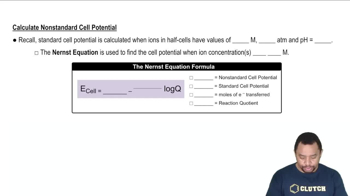
Nernst Equation
The Nernst Equation relates the cell potential to the concentrations of the reactants and products in an electrochemical cell. It is expressed as E = E° - (RT/nF) ln(Q), where E is the cell potential, E° is the standard cell potential, R is the gas constant, T is the temperature in Kelvin, n is the number of moles of electrons transferred, F is Faraday's constant, and Q is the reaction quotient. This equation is essential for calculating the potential of concentration cells.
추천 영상:
가이드 코스
The Nernst Equation
Concentration Cell
A concentration cell is a type of electrochemical cell where both half-cells contain the same species but at different concentrations. The potential difference arises from the difference in concentration, driving the spontaneous flow of electrons from the higher concentration to the lower concentration. Understanding this concept is crucial for analyzing how concentration differences can generate electrical energy.
추천 영상:
가이드 코스
The Electrolytic Cell
Reaction Quotient (Q)
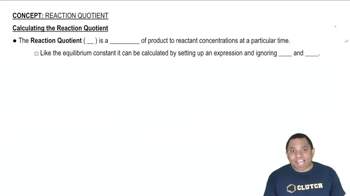
The reaction quotient (Q) is a measure of the relative concentrations of reactants and products at any point in a reaction. For a concentration cell involving Sn/Sn2+, Q is calculated as the ratio of the concentrations of Sn2+ in the two half-cells. This ratio is directly related to the cell potential, making it vital for determining the concentration difference that leads to the observed voltage.
추천 영상:
가이드 코스
Reaction Quotient Q
관련 실천
교과서 질문
3843
views
교과서 질문
Determine the optimum mass ratio of Zn to MnO2 in an alkaline battery.
401
views
교과서 질문
Consider the concentration cell:
c. Indicate what happens to the concentration of Pb2+ in each half-cell.
598
views
교과서 질문
What mass of lead sulfate is formed in a lead–acid storage battery when 1.00 g of Pb undergoes oxidation?
493
views
교과서 질문
Make a sketch of a concentration cell employing two Zn/Zn2+ half-cells. The concentration of Zn2+ in one of the half-cells is 2.0 M and the concentration in the other half-cell is 1.0×10⁻³ M. Label the anode and the cathode and indicate the half-reaction occuring at each electrode. Also indicate the direction of electron flow.
980
views
교과서 질문
Consider the concentration cell: b. Indicate the direction of electron flow.
672
views
