
Ch.20 - Electrochemistry
Tro - Chemistry: A Molecular Approach 6th Edition
Tro6th EditionChemistry: A Molecular ApproachISBN: 9780137832217당신이 사용하는 게 아니라요?교과서 변경
20장, 문제 120a

A rechargeable battery is constructed based on a concentration cell constructed of two Ag/Ag+ half-cells. The volume of each half-cell is 2.0 L, and the concentrations of Ag+ in the half-cells are 1.25 M and 1.0×10⁻³ M. a. How long can this battery deliver 2.5 Aof current before it goes dead?

검증된 단계별 안내
1
Identify the half-reactions for the concentration cell. In a concentration cell, the same species is involved in both half-reactions, but at different concentrations. Here, the half-reaction is Ag+ + e- → Ag for both electrodes.
Calculate the cell potential (Ecell) using the Nernst equation: Ecell = E°cell - (RT/nF) * ln(Q), where E°cell is 0 for a concentration cell, R is the gas constant (8.314 J/mol·K), T is the temperature in Kelvin, n is the number of moles of electrons transferred (1 for Ag/Ag+), F is Faraday's constant (96485 C/mol), and Q is the reaction quotient, which is the ratio of the concentrations of Ag+ in the two half-cells.
Substitute the given concentrations into the Nernst equation. The reaction quotient Q is [Ag+]anode/[Ag+]cathode = 1.0×10^-3 M / 1.25 M.
Determine the total charge (Q) that can be delivered by the battery using the formula Q = n * F, where n is the number of moles of electrons transferred. Since the current (I) is given as 2.5 A, use the relationship Q = I * t to find the time (t) the battery can deliver this current.
Solve for time (t) using the equation t = Q/I, where Q is the total charge calculated in the previous step and I is the current (2.5 A). This will give you the duration for which the battery can deliver the specified current before it goes dead.

비슷한 문제에 대한 검증된 영상 답변:

이 영상 해법은 위 문제에 도움이 된다고 튜터들이 추천한 것입니다.
영상 길이:
4m
도움이 되었나요?

주요 개념

질문에 올바르게 답하기 위해 반드시 이해해야 하는 핵심 개념들은 다음과 같습니다.

Concentration Cells

A concentration cell is a type of electrochemical cell where the electrodes are the same material but are immersed in solutions of different concentrations. The potential difference arises from the difference in concentration of ions, driving the flow of electrons from the higher concentration to the lower concentration. This principle is crucial for understanding how the battery operates and generates electrical energy.
추천 영상:
가이드 코스
01:21
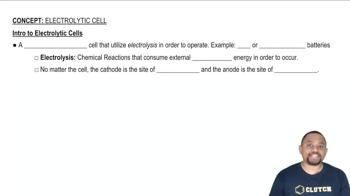
The Electrolytic Cell

Nernst Equation

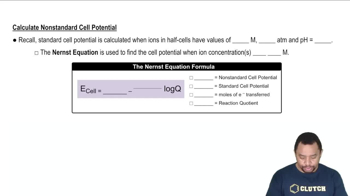
The Nernst equation relates the cell potential to the concentrations of the reactants and products in an electrochemical reaction. It allows for the calculation of the electromotive force (EMF) of the cell based on the concentration of ions. This equation is essential for determining how the varying concentrations of Ag<sup>+</sup> in the half-cells affect the overall voltage and performance of the battery.
추천 영상:
가이드 코스
01:17
The Nernst Equation

Current and Time Relationship

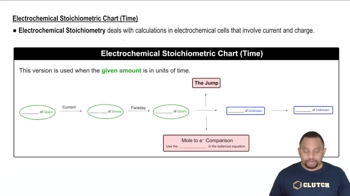
The relationship between current, charge, and time is described by the equation Q = I × t, where Q is the total charge, I is the current, and t is the time. This concept is vital for calculating how long the battery can deliver a specific current before depleting its charge. Understanding this relationship helps in determining the operational duration of the battery based on its capacity and the current draw.
추천 영상:
가이드 코스
02:16
Electrochemical Stoichiometric Chart (Time)
관련 실천
교과서 질문

A rechargeable battery is constructed based on a concentration cell constructed of two Ag/Ag+ half-cells. The volume of each half-cell is 2.0 L, and the concentrations of Ag+ in the half-cells are 1.25 M and 1.0 × 10⁻³ M. b. What mass of silver is plated onto the cathode by running at 3.5 A for 5.5 h?

427
views
교과서 질문

A battery relies on the oxidation of magnesium and the reduction of Cu2+. The initial concentrations of Mg2+ and Cu2+ are 1.0 × 10⁻⁴ M and 1.5 M, respectively, in 1.0-liter half-cells. b. What is the voltage of the battery after delivering 5.0 A for 8.0 h?

414
views
1
rank
교과서 질문

A battery relies on the oxidation of magnesium and the reduction of Cu2+. The initial concentrations of Mg2+ and Cu2+ are 1.0 × 10⁻⁴ M and 1.5 M, respectively, in 1.0-liter half-cells. a. What is the initial voltage of the battery?

1435
views
교과서 질문

A battery relies on the oxidation of magnesium and the reduction of Cu2+. The initial concentrations of Mg2+ and Cu2+ are 1.0 × 10⁻⁴ M and 1.5 M, respectively, in 1.0-liter half-cells. c. How long can the battery deliver 5.0 A before going dead?

799
views
1
rank
1
comments
교과서 질문

A rechargeable battery is constructed based on a concentration cell constructed of two Ag/Ag+ half-cells. The volume of each half-cell is 2.0 L, and the concentrations of Ag+ in the half-cells are 1.25 M and 1.0 × 10⁻³ M. c. Upon recharging, how long would it take to redissolve 1.00 × 10² g of silver at a charging current of 10.0 amps?

657
views