Balance each redox reaction occurring in basic aqueous solution. c. NO2–(aq) + Al(s) → NH3(g) + AlO2–(aq)
Ch.20 - Electrochemistry

20장, 문제 49
Calculate the standard cell potential for each of the electro- chemical cells in Problem 43.
검증된 단계별 안내1
First, identify the half-reactions involved in the electrochemical cell. The half-reactions are usually given in the problem or can be determined from the cell diagram.
Next, look up the standard reduction potentials for each half-reaction in a table of standard reduction potentials. These tables can be found in your textbook or online.
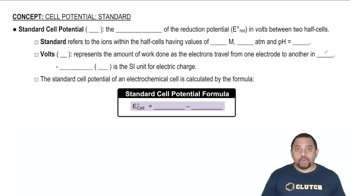
Remember that the standard cell potential is calculated by subtracting the standard reduction potential of the reaction at the anode (where oxidation occurs) from the standard reduction potential of the reaction at the cathode (where reduction occurs). This can be represented by the equation: E°cell = E°cathode - E°anode.
Substitute the standard reduction potentials you found in step 2 into the equation from step 3. Be careful with the signs of the potentials, as they can be positive or negative.
Finally, calculate the standard cell potential. This will give you the maximum potential difference, or voltage, that the cell can produce under standard conditions. Remember that a positive cell potential indicates a spontaneous reaction, while a negative cell potential indicates a non-spontaneous reaction.

비슷한 문제에 대한 검증된 영상 답변:
이 영상 해법은 위 문제에 도움이 된다고 튜터들이 추천한 것입니다.
영상 길이:
4m주요 개념
질문에 올바르게 답하기 위해 반드시 이해해야 하는 핵심 개념들은 다음과 같습니다.
Standard Cell Potential
The standard cell potential (E°) is the measure of the voltage produced by an electrochemical cell under standard conditions (1 M concentration, 1 atm pressure, and 25°C). It is calculated using the standard reduction potentials of the half-reactions involved in the cell. A positive E° indicates a spontaneous reaction, while a negative E° suggests non-spontaneity.
추천 영상:
가이드 코스
Standard Cell Potential
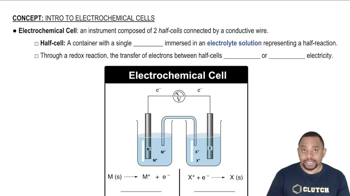
Electrochemical Cells
Electrochemical cells consist of two half-cells, each containing an electrode and an electrolyte. The oxidation reaction occurs at the anode, while the reduction reaction takes place at the cathode. The flow of electrons from the anode to the cathode through an external circuit generates electrical energy, which can be harnessed for work.
추천 영상:
가이드 코스
Electrochemical Cells
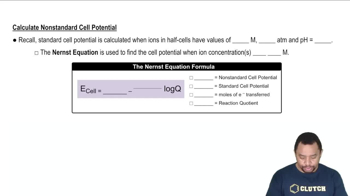
Nernst Equation
The Nernst equation relates the cell potential to the concentrations of the reactants and products in an electrochemical reaction. It allows for the calculation of the cell potential under non-standard conditions and is expressed as E = E° - (RT/nF)ln(Q), where R is the gas constant, T is the temperature in Kelvin, n is the number of moles of electrons transferred, F is Faraday's constant, and Q is the reaction quotient.
추천 영상:
가이드 코스
The Nernst Equation
관련 실천
교과서 질문
1403
views
교과서 질문
Consider the voltaic cell:
d. Indicate the direction of anion and cation flow in the salt bridge
867
views
교과서 질문
Use line notation to represent each electrochemical cell in Problem 43.
945
views
교과서 질문
Sketch a voltaic cell for each redox reaction. Label the anode and cathode and indicate the half-reaction that occurs at each electrode and the species present in each solution. Also indicate the direction of electron flow. a. Ni2+(aq) + Mg(s) → Ni(s) + Mg2+(aq)
2319
views
1
rank
교과서 질문
Balance each redox reaction occurring in basic aqueous solution. b. Ag(s) + CN–(aq) + O2(g) → Ag(CN)2–(aq)
1104
views
1
rank
교과서 질문
Make a sketch of the voltaic cell represented by the line notation. Write the overall balanced equation for the reaction and calculate E°cell. Sn(s) | Sn2+(aq) || NO(g) | NO3–(aq), H+(aq) | Pt(s)
890
views
1
rank