
Ch.20 - Electrochemistry
Tro - Chemistry: A Molecular Approach 6th Edition
Tro6th EditionChemistry: A Molecular ApproachISBN: 9780137832217당신이 사용하는 게 아니라요?교과서 변경
20장, 문제 113c

Determine whether HI can dissolve each metal sample. If it can, write a balanced chemical reaction showing how the metal dissolves in HI and determine the minimum volume of 3.5 M HI required to completely dissolve the sample. c. 2.42 g Ag

검증된 단계별 안내
1
Identify the reaction: Determine if HI can react with silver (Ag). Silver is less reactive and does not react with non-oxidizing acids like HI, so no reaction occurs.
Since no reaction occurs, there is no need to write a balanced chemical equation for the dissolution of silver in HI.
Understand the reactivity series: Silver is below hydrogen in the reactivity series, indicating it does not react with acids like HI to produce hydrogen gas.
Conclude that since silver does not react with HI, no volume of HI is required to dissolve the silver sample.
Reaffirm the concept: The reactivity series helps predict whether a metal will react with an acid. Metals above hydrogen in the series can displace hydrogen from acids, while those below, like silver, cannot.

비슷한 문제에 대한 검증된 영상 답변:

이 영상 해법은 위 문제에 도움이 된다고 튜터들이 추천한 것입니다.
영상 길이:
4m
도움이 되었나요?

주요 개념

질문에 올바르게 답하기 위해 반드시 이해해야 하는 핵심 개념들은 다음과 같습니다.

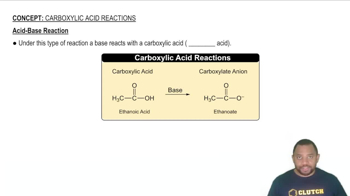
Acid-Base Reactions

Acid-base reactions involve the transfer of protons (H+) between reactants. In this context, hydroiodic acid (HI) acts as a strong acid that can donate protons, potentially reacting with metals like silver (Ag). Understanding how acids interact with metals is crucial for predicting whether a metal will dissolve in an acid and for writing balanced chemical equations.
추천 영상:
가이드 코스
01:09
Acid-Base Reaction

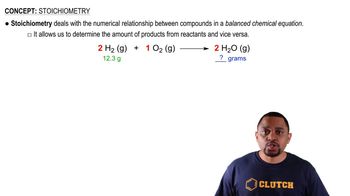
Stoichiometry

Stoichiometry is the calculation of reactants and products in chemical reactions based on the conservation of mass. It allows us to determine the amounts of substances involved in a reaction. In this case, stoichiometry will help calculate the minimum volume of 3.5 M HI needed to dissolve 2.42 g of Ag by using the molar mass of silver and the balanced chemical equation.
추천 영상:
가이드 코스
01:16
Stoichiometry Concept

Molarity

Molarity (M) is a measure of concentration defined as the number of moles of solute per liter of solution. In this problem, the concentration of HI is given as 3.5 M, which is essential for calculating the volume required to dissolve the silver sample. Understanding molarity is key to performing dilution calculations and determining how much of a solution is needed to achieve a desired reaction.
추천 영상:
관련 실천
교과서 질문

The cell potential of this electrochemical cell depends on the gold concentration in the cathode half-cell. Pt(s) | H2(g, 1.0 atm) | H+(aq, 1.0 M) || Au3+(aq, ? M) | Au(s) What is the concentration of Au3+ in the solution if Ecell is 1.22 V?

2237
views
교과서 질문

Consider the unbalanced redox reaction: Cr2O72-(aq) + Cu(s) → Cr3+(aq) + Cu2+(aq) Balance the equation and determine the volume of a 0.850 M K2Cr2O7 solution required to completely react with 5.25 g of Cu.

2265
views
1
rank
교과서 질문

Determine if HNO3 can dissolve each metal sample. If it can, write a balanced chemical reaction showing how the metal dissolves in HNO3 and determine the minimum volume of 6.0 M HNO3 required to completely dissolve the sample. a. 5.90 g Au b. 2.55 g Cu c. 4.83 g Sn

753
views
교과서 질문

Determine whether HI can dissolve each metal sample. If it can, write a balanced chemical reaction showing how the metal dissolves in HI and determine the minimum volume of 3.5 M HI required to completely dissolve the sample. a. 2.15 g Al

712
views
교과서 질문

Determine whether HI can dissolve each metal sample. If it can, write a balanced chemical reaction showing how the metal dissolves in HI and determine the minimum volume of 3.5 M HI required to completely dissolve the sample. b. 4.85 g Cu

482
views
교과서 질문

The cell potential of this electrochemical cell depends on the pH of the solution in the anode half-cell. Pt(s) | H2(g, 1 atm) | H+(aq, ? M) || Cu2+(aq, 1.0 M) | Cu(s) What is the pH of the solution if Ecell is 355 mV?

2744
views
1
rank