A typical home uses approximately 1.0⨉103 kWh of energy per month. If the energy came from a nuclear reaction, what mass would have to be converted to energy per year to meet the energy needs of the home?
Ch.21 - Radioactivity & Nuclear Chemistry

21장, 문제 70
Calculate the mass defect and nuclear binding energy per nucleon of each nuclide. a. Li-7 (atomic mass = 7.016003 amu)
검증된 단계별 안내1

비슷한 문제에 대한 검증된 영상 답변:
이 영상 해법은 위 문제에 도움이 된다고 튜터들이 추천한 것입니다.
영상 길이:
8m주요 개념
질문에 올바르게 답하기 위해 반드시 이해해야 하는 핵심 개념들은 다음과 같습니다.
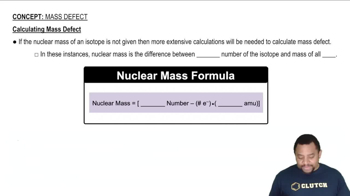
Mass Defect
The mass defect is the difference between the mass of an atomic nucleus and the sum of the individual masses of its protons and neutrons. This discrepancy arises because some mass is converted into energy when nucleons bind together, according to Einstein's equation E=mc². The mass defect is crucial for understanding nuclear stability and energy release in nuclear reactions.
추천 영상:
가이드 코스
Calculating Mass Defect
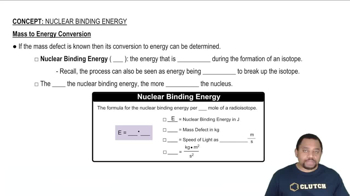
Nuclear Binding Energy
Nuclear binding energy is the energy required to disassemble a nucleus into its constituent protons and neutrons. It is directly related to the mass defect; the greater the mass defect, the higher the binding energy. This energy is a measure of the stability of a nucleus: a higher binding energy indicates a more stable nucleus, while a lower binding energy suggests it is more likely to undergo radioactive decay.
추천 영상:
가이드 코스
Nuclear Binding Energy
Binding Energy per Nucleon
Binding energy per nucleon is the average energy that binds each nucleon (proton or neutron) in a nucleus. It is calculated by dividing the total binding energy of the nucleus by the number of nucleons. This value is useful for comparing the stability of different nuclei; generally, nuclei with higher binding energy per nucleon are more stable and less likely to undergo fission or fusion.
추천 영상:
가이드 코스
Nuclear Binding Energy
관련 실천
교과서 질문
669
views
2
rank
교과서 질문
Calculate the quantity of energy produced per mole of U-235 (atomic mass = 235.043922 amu) for the neutron-induced fission of U-235 to produce Te-137 (atomic mass = 136.9253 amu) and Zr-97 (atomic mass = 96.910950 amu) (discussed in Problem 58).
108
views
교과서 질문
If 1.0 g of matter is converted to energy, how much energy is formed?
697
views
1
rank
1
comments
교과서 질문
Calculate the quantity of energy produced per gram of U-235 (atomic mass = 235.043922 amu) for the neutron-induced fission of U-235 to form Xe-144 (atomic mass = 143.9385 amu) and Sr-90 (atomic mass = 89.907738 amu) (discussed in Problem 57).
1943
views
1
rank