Ch.22 - Organic Chemistry
Tro - Chemistry: A Molecular Approach 6th Edition
Tro6th EditionChemistry: A Molecular ApproachISBN: 9780137832217당신이 사용하는 게 아니라요?교과서 변경
22장, 문제 39c

Determine whether each compound exhibits optical isomerism c.

검증된 단계별 안내
1
Identify the presence of a chiral center in the compound. A chiral center is typically a carbon atom bonded to four different groups.
Check if the compound is symmetrical. Optical isomerism usually occurs in asymmetrical molecules.
Determine if the compound can exist in non-superimposable mirror images, which is a key characteristic of optical isomers.
Consider the molecular structure and spatial arrangement of atoms to see if the compound can have enantiomers.
If the compound meets these criteria, it exhibits optical isomerism; otherwise, it does not.

비슷한 문제에 대한 검증된 영상 답변:

이 영상 해법은 위 문제에 도움이 된다고 튜터들이 추천한 것입니다.
영상 길이:
1m
도움이 되었나요?

주요 개념

질문에 올바르게 답하기 위해 반드시 이해해야 하는 핵심 개념들은 다음과 같습니다.

Optical Isomerism

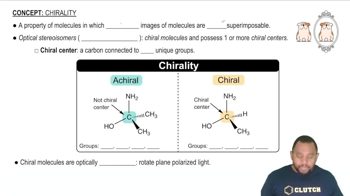
Optical isomerism, also known as chirality, occurs when a molecule can exist in two non-superimposable mirror image forms called enantiomers. These isomers have identical physical properties except for the direction in which they rotate plane-polarized light. The presence of a chiral center, typically a carbon atom bonded to four different substituents, is a key factor in determining whether a compound exhibits optical isomerism.
추천 영상:
가이드 코스
2:14
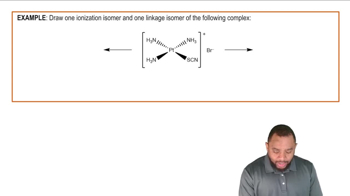
Isomerism in Coordination Complexes Example

Chiral Centers

A chiral center, often a carbon atom, is a point in a molecule where four different groups are attached, leading to the possibility of forming two distinct stereoisomers. The arrangement of these groups around the chiral center determines the molecule's chirality. Identifying chiral centers is essential for assessing whether a compound can exhibit optical isomerism.
추천 영상:

Stereoisomerism

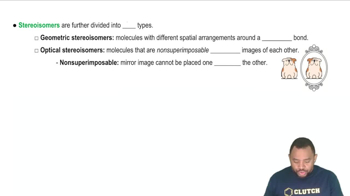
Stereoisomerism refers to the phenomenon where molecules have the same molecular formula and connectivity of atoms but differ in the spatial arrangement of their atoms. This category includes optical isomers, which are specifically related to the orientation of substituents around chiral centers. Understanding stereoisomerism is crucial for determining the optical activity of compounds and their potential isomeric forms.
추천 영상: