Ch.3 - Molecules and Compounds
Tro - Chemistry: A Molecular Approach 6th Edition
Tro6th EditionChemistry: A Molecular ApproachISBN: 9780137832217당신이 사용하는 게 아니라요?교과서 변경
3장, 문제 123

A Freon leak in the air-conditioning system of an old car releases 38.0 g of CF2Cl2 per month. What mass of chlorine does this car emit into the atmosphere each year?

검증된 단계별 안내
1
Determine the molar mass of CF_2Cl_2 by adding the atomic masses of its constituent atoms: C, F, and Cl.
Calculate the number of moles of CF_2Cl_2 released per month by dividing the mass released (38.0 g) by the molar mass of CF_2Cl_2.
Determine the number of moles of chlorine atoms in the moles of CF_2Cl_2, considering that each molecule of CF_2Cl_2 contains two chlorine atoms.
Calculate the mass of chlorine released per month by multiplying the moles of chlorine by the atomic mass of chlorine.
Calculate the total mass of chlorine released per year by multiplying the monthly chlorine mass by 12 (months in a year).

비슷한 문제에 대한 검증된 영상 답변:

이 영상 해법은 위 문제에 도움이 된다고 튜터들이 추천한 것입니다.
영상 길이:
5m

주요 개념

질문에 올바르게 답하기 위해 반드시 이해해야 하는 핵심 개념들은 다음과 같습니다.

Molar Mass Calculation

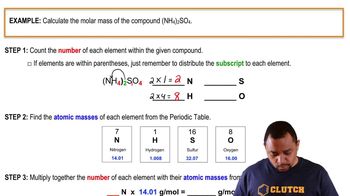
To determine the mass of chlorine emitted, one must first calculate the molar mass of CF2Cl2 (dichlorodifluoromethane). The molar mass is the sum of the atomic masses of all atoms in the molecule: carbon (C), fluorine (F), and chlorine (Cl). This calculation is essential for converting grams of CF2Cl2 to moles, which will then allow for the determination of the mass of chlorine released.
추천 영상:
가이드 코스
03:12
Molar Mass Calculation Example

Stoichiometry

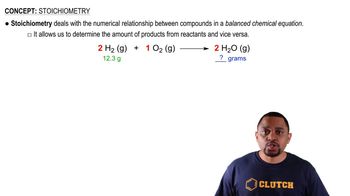
Stoichiometry is the branch of chemistry that deals with the relationships between the quantities of reactants and products in a chemical reaction. In this case, it involves using the mole ratio from the chemical formula of CF2Cl2 to find out how many moles of chlorine are present in the given mass of CF2Cl2. This step is crucial for converting the amount of CF2Cl2 released into the corresponding mass of chlorine.
추천 영상:
가이드 코스
01:16
Stoichiometry Concept

Annual Emission Calculation

To find the annual emission of chlorine, one must multiply the monthly release of CF2Cl2 by 12 months. This calculation provides the total mass of CF2Cl2 released in a year, which can then be used to find the total mass of chlorine emitted. Understanding how to scale monthly emissions to an annual basis is important for environmental assessments and regulatory compliance.
추천 영상:
가이드 코스
01:51
Emission Spectra