Ch.3 - Molecules and Compounds
Tro - Chemistry: A Molecular Approach 6th Edition
Tro6th EditionChemistry: A Molecular ApproachISBN: 9780137832217당신이 사용하는 게 아니라요?교과서 변경
3장, 문제 72a

Determine the number of moles (of molecules or formula units) in each sample. a. 55.98 g CF2Cl2

검증된 단계별 안내
1
Step 1: Identify the molar mass of CF2Cl2.
Step 2: Calculate the molar mass by adding the atomic masses of each element in the compound.
Step 3: Use the formula: number of moles = mass of sample (g) / molar mass (g/mol).
Step 4: Substitute the given mass of CF2Cl2 and the calculated molar mass into the formula.
Step 5: Solve the equation to find the number of moles of CF2Cl2 in the sample.

비슷한 문제에 대한 검증된 영상 답변:

이 영상 해법은 위 문제에 도움이 된다고 튜터들이 추천한 것입니다.
영상 길이:
1m
도움이 되었나요?

주요 개념

질문에 올바르게 답하기 위해 반드시 이해해야 하는 핵심 개념들은 다음과 같습니다.

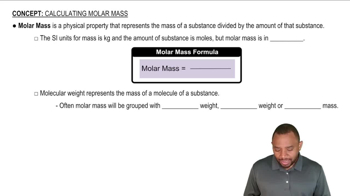
Molar Mass

Molar mass is the mass of one mole of a substance, typically expressed in grams per mole (g/mol). It is calculated by summing the atomic masses of all atoms in a molecule. For CF2Cl2, the molar mass can be determined by adding the atomic masses of carbon (C), fluorine (F), and chlorine (Cl) based on their respective quantities in the formula.
추천 영상:
가이드 코스
02:11
Molar Mass Concept

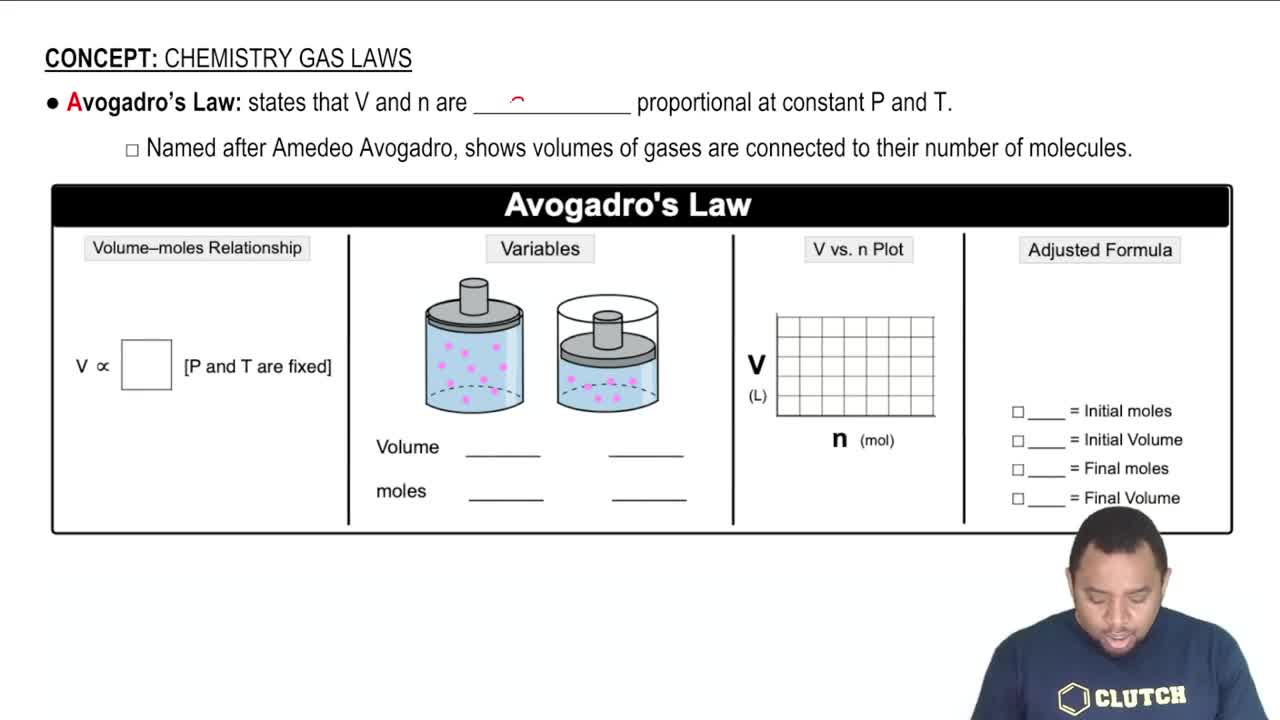
Avogadro's Number

Avogadro's number, approximately 6.022 x 10^23, is the number of particles (atoms, molecules, or formula units) in one mole of a substance. This constant allows chemists to convert between the number of moles and the number of individual particles, facilitating calculations in stoichiometry and chemical reactions.
추천 영상:

Mole Calculation

To determine the number of moles in a sample, the formula used is: moles = mass (g) / molar mass (g/mol). By applying this formula to the given mass of CF2Cl2, one can find the number of moles present in the sample, which is essential for understanding the quantity of molecules involved in chemical reactions.
추천 영상: