Ch.5 - Introduction to Solutions and Aqueous Solutions
Tro - Chemistry: A Molecular Approach 6th Edition
Tro6th EditionChemistry: A Molecular ApproachISBN: 9780137832217당신이 사용하는 게 아니라요?교과서 변경
5장, 문제 92

A solution contains Cr3+ ions and Mg2+ ions. The addition of 1.00 L of 1.51 M NaF solution causes the complete precipitation of these ions as CrF3(s) and MgF2(s). The total mass of the precipitate is 49.6 g. Find the mass of Cr3+ in the original solution.

검증된 단계별 안내
1
Determine the moles of NaF added using the concentration and volume: \( \text{moles of NaF} = 1.51 \text{ M} \times 1.00 \text{ L} \).
Write the balanced chemical equations for the precipitation reactions: \( \text{Cr}^{3+} + 3\text{F}^- \rightarrow \text{CrF}_3(s) \) and \( \text{Mg}^{2+} + 2\text{F}^- \rightarrow \text{MgF}_2(s) \).
Calculate the moles of \( \text{CrF}_3 \) and \( \text{MgF}_2 \) that can be formed using the stoichiometry of the reactions and the moles of NaF available.
Use the molar masses of \( \text{CrF}_3 \) and \( \text{MgF}_2 \) to express the total mass of the precipitate in terms of the moles of \( \text{CrF}_3 \) and \( \text{MgF}_2 \).
Set up an equation for the total mass of the precipitate (49.6 g) and solve for the moles of \( \text{CrF}_3 \), then calculate the mass of \( \text{Cr}^{3+} \) in the original solution.

비슷한 문제에 대한 검증된 영상 답변:

이 영상 해법은 위 문제에 도움이 된다고 튜터들이 추천한 것입니다.
영상 길이:
10m

주요 개념

질문에 올바르게 답하기 위해 반드시 이해해야 하는 핵심 개념들은 다음과 같습니다.

Stoichiometry

Stoichiometry is the calculation of reactants and products in chemical reactions. It involves using balanced chemical equations to determine the relationships between the amounts of substances consumed and produced. In this question, stoichiometry is essential for relating the moles of Cr<sup>3+</sup> and Mg<sup>2+</sup> ions to the moles of their respective precipitates, CrF<sub>3</sub> and MgF<sub>2</sub>.
추천 영상:
가이드 코스
01:16
Stoichiometry Concept

Precipitation Reactions

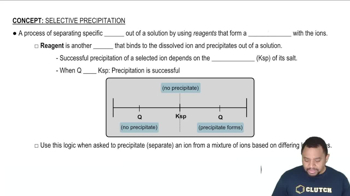
Precipitation reactions occur when two soluble salts react in solution to form an insoluble solid, known as a precipitate. In this case, the addition of NaF leads to the formation of CrF<sub>3</sub> and MgF<sub>2</sub> precipitates. Understanding the solubility rules and the conditions under which these ions precipitate is crucial for determining the mass of the original ions in the solution.
추천 영상:
가이드 코스
01:53
Selective Precipitation

Molar Mass

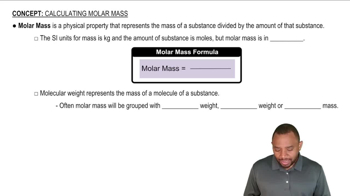
Molar mass is the mass of one mole of a substance, typically expressed in grams per mole (g/mol). It is used to convert between the mass of a substance and the number of moles. In this problem, calculating the mass of Cr<sup>3+</sup> requires knowing its molar mass to relate the total mass of the precipitate to the moles of Cr<sup>3+</sup> that contributed to the formation of CrF<sub>3</sub>.
추천 영상:
가이드 코스
02:11
Molar Mass Concept
관련 실천
교과서 질문

Treatment of gold metal with BrF3 and KF produces Br2 and KAuF4, a salt of gold. Identify the oxidizing agent and the reducing agent in this reaction.

906
views

교과서 질문

Find the mass of barium metal (in grams) that must react with O2 to produce enough barium oxide to prepare 1.0 L of a 0.10 M solution of OH-.

1366
views
교과서 질문

Hard water often contains dissolved Ca2+ and Mg2+ ions. One way to soften water is to add phosphates. The phosphate ion forms insoluble precipitates with calcium and magnesium ions, removing them from solution. A solution is 0.050 M in calcium chloride and 0.085 M in magnesium nitrate. What mass of sodium phosphate would you add to 1.5 L of this solution to completely eliminate the hard water ions? Assume complete reaction.

3115
views
2
comments
교과서 질문

Treatment of gold metal with BrF3 and KF produces Br2 and KAuF4, a salt of gold. Find the mass of the gold salt that forms when a 73.5-g mixture of equal masses of all three reactants is prepared.

2630
views
교과서 질문

An acid solution is 0.100 M in HCl and 0.200 M in H2SO4. What volume of a 0.150 M KOH solution would completely neutralize all the acid in 500.0 mL of this solution?

2414
views
교과서 질문

A solution contains one or more of the following ions: Ag+ , Ca2+ , and Cu2+ . When you add sodium chloride to the solution, no precipitate forms. When you add sodium sulfate to the solution, a white precipitate forms. You filter off the precipitate and add sodium carbonate to the remaining solution, producing another precipitate. Write net ionic equations for the formation of each of the precipitates observed.

3087
views