
Ch.5 - Introduction to Solutions and Aqueous Solutions
Tro - Chemistry: A Molecular Approach 6th Edition
Tro6th EditionChemistry: A Molecular ApproachISBN: 9780137832217당신이 사용하는 게 아니라요?교과서 변경
5장, 문제 96b

A solution contains one or more of the following ions: Hg22+, Ba2+, and Fe2+. When you add potassium chloride to the solution, a precipitate forms. The precipitate is filtered off, and you add potassium sulfate to the remaining solution, producing no precipitate. When you add potassium carbonate to the remaining solution, a precipitate forms. Write net ionic equations for the formation of each of the precipitates observed.

검증된 단계별 안내
1
Identify the ions present in the solution: Hg_2^{2+}, Ba^{2+}, and Fe^{2+}.
Add potassium chloride (KCl) to the solution. The chloride ions (Cl^-) will react with Hg_2^{2+} to form a precipitate of mercury(I) chloride (Hg_2Cl_2). Write the net ionic equation: Hg_2^{2+} (aq) + 2Cl^- (aq) -> Hg_2Cl_2 (s).
Filter off the precipitate and add potassium sulfate (K_2SO_4) to the remaining solution. Since no precipitate forms, Ba^{2+} ions are not present in the solution, as barium sulfate (BaSO_4) would have precipitated.
Add potassium carbonate (K_2CO_3) to the remaining solution. The carbonate ions (CO_3^{2-}) will react with Fe^{2+} to form a precipitate of iron(II) carbonate (FeCO_3). Write the net ionic equation: Fe^{2+} (aq) + CO_3^{2-} (aq) -> FeCO_3 (s).
Summarize the net ionic equations for the precipitates: 1) Hg_2^{2+} (aq) + 2Cl^- (aq) -> Hg_2Cl_2 (s), 2) Fe^{2+} (aq) + CO_3^{2-} (aq) -> FeCO_3 (s).

비슷한 문제에 대한 검증된 영상 답변:

이 영상 해법은 위 문제에 도움이 된다고 튜터들이 추천한 것입니다.
영상 길이:
2m
도움이 되었나요?

주요 개념

질문에 올바르게 답하기 위해 반드시 이해해야 하는 핵심 개념들은 다음과 같습니다.

Solubility Rules

Solubility rules are guidelines that help predict whether a compound will dissolve in water. For example, most chlorides are soluble, except for those of silver, lead, and mercury. In contrast, sulfates are generally soluble, but barium sulfate is an exception. Understanding these rules is crucial for determining which ions will precipitate when mixed.
추천 영상:
가이드 코스
00:28
Solubility Rules

Precipitation Reactions

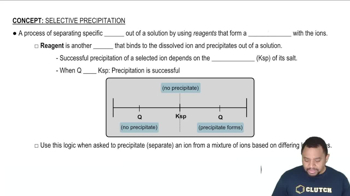
Precipitation reactions occur when two soluble salts react in solution to form an insoluble compound, known as a precipitate. This process can be represented by net ionic equations, which focus on the ions that participate in the formation of the precipitate. Identifying the ions involved and their solubility is essential for writing accurate equations.
추천 영상:
가이드 코스
01:53
Selective Precipitation

Net Ionic Equations

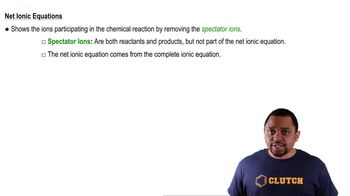
Net ionic equations represent the actual chemical species that participate in a reaction, excluding spectator ions that do not change during the reaction. To write a net ionic equation, one must first identify the reactants, determine the products, and then eliminate the ions that remain unchanged. This simplification helps clarify the essential chemical changes occurring in the reaction.
추천 영상:
가이드 코스
00:51
Net Ionic Equations