What is the oxidation state of Cl in each ion? a. ClO- b. ClO2- c. ClO3- d. ClO4-
Ch.5 - Introduction to Solutions and Aqueous Solutions

5장, 문제 73a
Determine whether each reaction is a redox reaction. For each redox reaction, identify the oxidizing agent and the reducing agent. a. 4 Li(s) + O2(g) → 2 Li2O(s) b. Mg(s) + Fe2+(aq) → Mg2+(aq) + Fe(s)
검증된 단계별 안내1
Step 1: Identify the oxidation states of each element in the reactants and products for both reactions.
Step 2: For reaction (a), assign oxidation states: Li in Li(s) is 0, O in O2(g) is 0, Li in Li2O(s) is +1, and O in Li2O(s) is -2.
Step 3: For reaction (b), assign oxidation states: Mg in Mg(s) is 0, Fe in Fe2+(aq) is +2, Mg in Mg2+(aq) is +2, and Fe in Fe(s) is 0.
Step 4: Determine if there is a change in oxidation states for each reaction. If there is a change, it is a redox reaction.
Step 5: Identify the oxidizing and reducing agents: The substance that is reduced (gains electrons) is the oxidizing agent, and the substance that is oxidized (loses electrons) is the reducing agent.

비슷한 문제에 대한 검증된 영상 답변:
이 영상 해법은 위 문제에 도움이 된다고 튜터들이 추천한 것입니다.
영상 길이:
2m도움이 되었나요?
주요 개념
질문에 올바르게 답하기 위해 반드시 이해해야 하는 핵심 개념들은 다음과 같습니다.
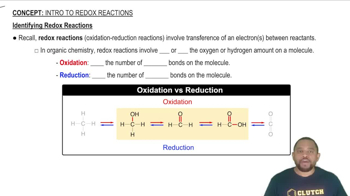
Redox Reactions
Redox reactions, or reduction-oxidation reactions, involve the transfer of electrons between two species. In these reactions, one species is oxidized (loses electrons) while another is reduced (gains electrons). Identifying these changes is crucial for determining the nature of the reaction and the roles of the reactants.
추천 영상:
가이드 코스
Identifying Redox Reactions
Oxidizing and Reducing Agents
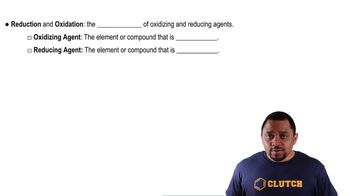
The oxidizing agent is the substance that gains electrons and is reduced in the process, while the reducing agent is the substance that loses electrons and is oxidized. Understanding these roles helps in identifying which reactants facilitate the electron transfer in a redox reaction, thus clarifying the overall process.
추천 영상:
가이드 코스
Oxidizing and Reducing Agents
Half-Reaction Method
The half-reaction method is a technique used to analyze redox reactions by separating the oxidation and reduction processes into two half-reactions. This method allows for a clearer understanding of electron transfer and helps in balancing the overall reaction, making it easier to identify the oxidizing and reducing agents.
추천 영상:
가이드 코스
Method 1 of Radioactive Half-Life
관련 실천
교과서 질문
1345
views
1
rank
교과서 질문
Determine whether each reaction is a redox reaction. For each redox reaction, identify the oxidizing agent and the reducing agent. c. Pb(NO3)2(aq) + Na2SO4(aq) → PbSO4(s) + 2 NaNO3(aq) d. HBr(aq) + KOH(aq) → H2O(l) + KBr(aq)
918
views
교과서 질문
What is the oxidation state of Cr in each compound? b. CrO3
604
views
교과서 질문
What is the oxidation state of Cr in each compound? c. Cr2O3
607
views
교과서 질문
Determine whether each reaction is a redox reaction. For each redox reaction, identify the oxidizing agent and the reducing agent. a. Al(s) + 3 Ag+(aq) → Al3+(aq) + 3 Ag(s) b. SO3(g) + H2O(l) → H2SO4(aq) c. Ba(s) + Cl2(g) → BaCl2(s) d. Mg(s) + Br2(l) → MgBr2(s)
498
views
교과서 질문
Find the percent by mass of sodium chloride in a 1.12 M NaCl solution. The density of the solution is 1.04 g/mL.