Ch.5 - Introduction to Solutions and Aqueous Solutions
Tro - Chemistry: A Molecular Approach 6th Edition
Tro6th EditionChemistry: A Molecular ApproachISBN: 9780137832217당신이 사용하는 게 아니라요?교과서 변경
5장, 문제 26a

what is the molarity of Br- in each solution? a. 0.100 M KBr

검증된 단계별 안내
1
Step 1: Understand the problem. We need to find the molarity of \( \text{Br}^- \) ions in a solution of \( 0.100 \text{ M} \) \( \text{KBr} \).
Step 2: Recognize that \( \text{KBr} \) is a strong electrolyte and dissociates completely in water into \( \text{K}^+ \) and \( \text{Br}^- \) ions.
Step 3: Write the dissociation equation: \( \text{KBr} \rightarrow \text{K}^+ + \text{Br}^- \).
Step 4: Note that the stoichiometry of the dissociation is 1:1, meaning each mole of \( \text{KBr} \) produces one mole of \( \text{Br}^- \).
Step 5: Conclude that the molarity of \( \text{Br}^- \) ions is the same as the initial molarity of \( \text{KBr} \), which is \( 0.100 \text{ M} \).

비슷한 문제에 대한 검증된 영상 답변:

이 영상 해법은 위 문제에 도움이 된다고 튜터들이 추천한 것입니다.
도움이 되었나요?

주요 개념

질문에 올바르게 답하기 위해 반드시 이해해야 하는 핵심 개념들은 다음과 같습니다.

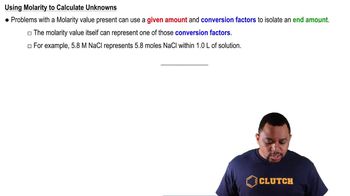
Molarity

Molarity is a measure of concentration defined as the number of moles of solute per liter of solution. It is expressed in units of moles per liter (M). Understanding molarity is essential for calculating the concentration of ions in a solution, as it allows for the conversion between moles of solute and the volume of the solution.
추천 영상:

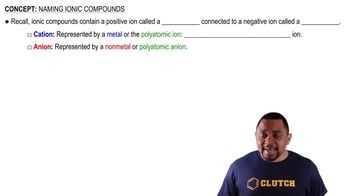
Dissociation of Ionic Compounds

Ionic compounds, such as potassium bromide (KBr), dissociate into their constituent ions when dissolved in water. For KBr, it separates into K<sup>+</sup> and Br<sup>-</sup> ions. This dissociation is crucial for determining the concentration of specific ions in solution, as the molarity of the compound directly translates to the molarity of its ions.
추천 영상:
가이드 코스
02:11
Ionic Compounds Naming

Stoichiometry in Solutions

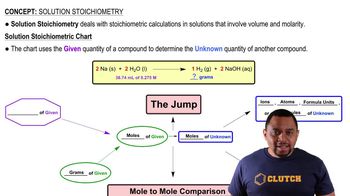
Stoichiometry involves the quantitative relationship between reactants and products in a chemical reaction. In the context of solutions, it helps in calculating the amounts of ions produced from a given concentration of an ionic compound. For example, knowing that 1 mole of KBr produces 1 mole of Br<sup>-</sup> allows us to directly relate the molarity of KBr to the molarity of Br<sup>-</sup> in solution.
추천 영상:
가이드 코스
03:10
Solution Stoichiometry