
교과서 질문
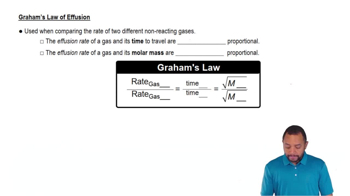
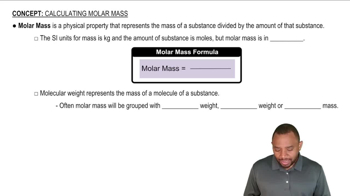
A sample of CO2 effuses from a container in 55 seconds. How long will it take the same amount of gaseous Xe to effuse from the same container under identical conditions?
1
views

 검증된 단계별 안내
 2:03
2:03
 02:11
02:11 00:44
00:44A sample of CO2 effuses from a container in 55 seconds. How long will it take the same amount of gaseous Xe to effuse from the same container under identical conditions?
Calculate the root mean square velocity and kinetic energy of CO, CO2, and SO3 at 298 K. Which gas has the greatest velocity? The greatest kinetic energy? The greatest effusion rate?
The graph shows the distribution of molecular velocities for the same molecule at two different temperatures (T1 and T2). Which temperature is greater? Explain.
Calculate the ratio of effusion rates for Ar and Kr.
The graph shows the distribution of molecular velocities for two different molecules (A and B) at the same temperature. Which molecule has the higher molar mass? Which molecule has the higher rate of effusion?
We separate U-235 from U-238 by fluorinating a sample of uranium to form UF6 (which is a gas) and then taking advantage of the different rates of effusion and diffusion for compounds containing the two isotopes. Calculate the ratio of effusion rates for 238UF6 and 235UF6. The atomic mass of U-235 is 235.054 amu and that of U-238 is 238.051 amu.