
A 2.0-L container of liquid nitrogen is kept in a closet measuring 1.0 m by 1.0 m by 2.0 m. Assuming that the container is completely full, that the temperature is 25.0°C, and that the atmospheric pressure is 1.0 atm, calculate the percent (by volume) of air that is displaced if all of the liquid nitrogen evaporates. (Liquid nitrogen has a density of 0.807 g/mL.)
Ch.6 - Gases

6장, 문제 55
Which gas sample has the greatest pressure? Assume that all the samples are at the same temperature. Explain.

검증된 단계별 안내1
Identify that pressure is directly related to the number of gas particles in a given volume, according to the ideal gas law (PV = nRT).
Observe the four flasks labeled a, b, c, and d, and note the number of gas particles in each flask.
Compare the density of gas particles in each flask visually.
Determine that the flask with the highest density of gas particles will have the greatest pressure, assuming all other conditions (temperature and volume) are constant.
Conclude which flask has the greatest pressure based on the visual comparison of particle density.

비슷한 문제에 대한 검증된 영상 답변:
이 영상 해법은 위 문제에 도움이 된다고 튜터들이 추천한 것입니다.
영상 길이:
1m도움이 되었나요?
주요 개념
질문에 올바르게 답하기 위해 반드시 이해해야 하는 핵심 개념들은 다음과 같습니다.
Gas Pressure
Gas pressure is defined as the force exerted by gas particles colliding with the walls of their container. It is influenced by the number of particles, their speed, and the volume of the container. According to the ideal gas law, pressure increases with more gas particles in a given volume, assuming temperature remains constant.
추천 영상:
가이드 코스
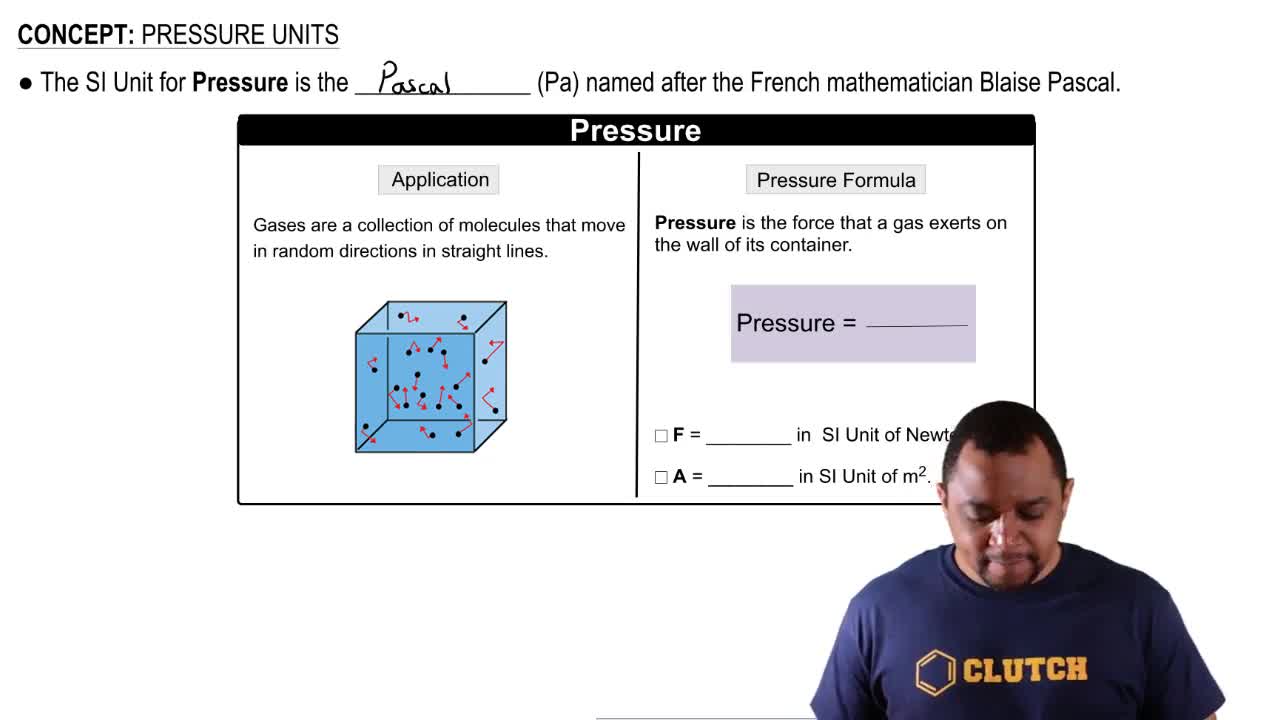
Pressure Units
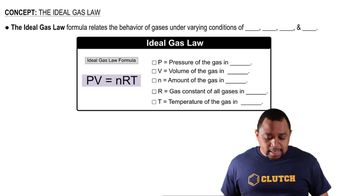
Ideal Gas Law
The ideal gas law is a fundamental equation in chemistry represented as PV = nRT, where P is pressure, V is volume, n is the number of moles of gas, R is the ideal gas constant, and T is temperature. This law helps predict the behavior of gases under various conditions and indicates that at constant temperature, pressure is directly proportional to the number of gas particles.
추천 영상:
가이드 코스
Ideal Gas Law Formula
Density of Gas
The density of a gas is defined as its mass per unit volume. In the context of gas samples, a higher density often indicates a greater number of gas particles in a given volume, which can lead to higher pressure. When comparing gas samples at the same temperature, the sample with the highest density will typically exert the greatest pressure.
추천 영상:
가이드 코스
Gas Density Example
관련 실천
교과서 질문
교과서 질문
This picture represents a sample of gas at a pressure of 1 atm, a volume of 1 L, and a temperature of 25 °C. Draw a similar picture showing what would happen to the sample if the volume were reduced to 0.5 L and the temperature were increased to 250 °C. What would happen to the pressure?
812
views
교과서 질문
Aerosol cans carry clear warnings against incineration because of the high pressures that can develop upon heating. Suppose that a can contains a residual amount of gas at a pressure of 755 mmHg and a temperature of 25 °C. What would the pressure be if the can were heated to 1155 °C?
3243
views
3
rank
교과서 질문
Write balanced complete ionic and net ionic equations for each reaction. a. HCl(aq) + LiOH(aq) → H2O(l) + LiCl(aq)
922
views
