Ch.6 - Gases
Tro - Chemistry: A Molecular Approach 6th Edition
Tro6th EditionChemistry: A Molecular ApproachISBN: 9780137832217당신이 사용하는 게 아니라요?교과서 변경
6장, 문제 1

Which postulate of the kinetic molecular theory breaks down under conditions of low temperature?

검증된 단계별 안내
1
Identify the postulates of the kinetic molecular theory. These include: 1) Gas particles are in constant, random motion. 2) The volume of the gas particles is negligible compared to the volume of the container. 3) Gas particles exert no forces on each other; they neither attract nor repel each other. 4) The average kinetic energy of gas particles is proportional to the temperature in Kelvin.
Consider the conditions of low temperature. At low temperatures, the kinetic energy of gas particles decreases.
Analyze how decreased kinetic energy affects the behavior of gas particles. With lower kinetic energy, the particles move more slowly and are more likely to experience intermolecular forces.
Determine which postulate is affected by these conditions. The postulate that gas particles exert no forces on each other breaks down because, at low temperatures, attractive forces between particles become significant.
Conclude that under low temperature conditions, the assumption that gas particles do not attract or repel each other is no longer valid, leading to deviations from ideal gas behavior.

주요 개념

질문에 올바르게 답하기 위해 반드시 이해해야 하는 핵심 개념들은 다음과 같습니다.

Kinetic Molecular Theory

The Kinetic Molecular Theory (KMT) explains the behavior of gases in terms of particles in constant motion. It posits that gas particles are in continuous, random motion and that their collisions with each other and the walls of their container are perfectly elastic. This theory helps to describe properties such as pressure, temperature, and volume in gases.
추천 영상:
가이드 코스
01:19
Kinetic Molecular Theory

Ideal Gas Behavior

Ideal gas behavior refers to the assumptions made in the Kinetic Molecular Theory that gases behave ideally under certain conditions, specifically at high temperatures and low pressures. Under these conditions, the volume of gas particles is negligible, and intermolecular forces are minimal. However, deviations from ideal behavior occur at low temperatures and high pressures, where interactions between particles become significant.
추천 영상:
가이드 코스
01:15
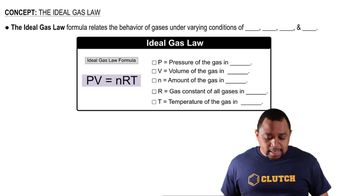
Ideal Gas Law Formula

Intermolecular Forces

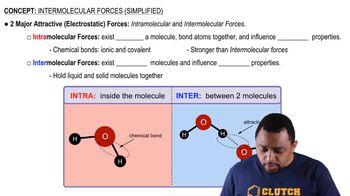
Intermolecular forces are the attractive or repulsive forces between molecules that influence their physical properties. At low temperatures, these forces become more pronounced as the kinetic energy of the particles decreases, leading to potential condensation or solidification. This breakdown of the assumption of negligible intermolecular forces is a key limitation of the Kinetic Molecular Theory under low-temperature conditions.
추천 영상:
가이드 코스
01:59
Intermolecular vs Intramolecular Forces