The average human lung expands by about 0.50 L during each breath. If this expansion occurs against an external pressure of 1.0 atm, how much work (in J) is done during the expansion?
Ch.7 - Thermochemistry

7장, 문제 52
An unknown mass of each substance, initially at 23.0 °C, absorbs 1.95 × 10³ J of heat. The final temperature is recorded. Find the mass of each substance.
a. Pyrex glass (Tf = 55.4°C)
b. sand (Tf = 62.1°C)
c. ethanol (Tf = 44.2°C)
d. water (Tf = 32.4°C)
검증된 단계별 안내1
Identify the specific heat capacity of Pyrex glass, which is typically around 0.75 J/g°C.
Use the formula for heat transfer: \( q = m \cdot c \cdot \Delta T \), where \( q \) is the heat absorbed, \( m \) is the mass, \( c \) is the specific heat capacity, and \( \Delta T \) is the change in temperature.
Calculate the change in temperature \( \Delta T \) using the initial and final temperatures: \( \Delta T = T_f - T_i = 55.4 \text{ °C} - 23.0 \text{ °C} \).
Rearrange the formula to solve for mass \( m \): \( m = \frac{q}{c \cdot \Delta T} \).
Substitute the known values into the rearranged formula: \( q = 1.95 \times 10^3 \text{ J} \), \( c = 0.75 \text{ J/g°C} \), and \( \Delta T \) calculated in the previous step, to find the mass \( m \).

비슷한 문제에 대한 검증된 영상 답변:
이 영상 해법은 위 문제에 도움이 된다고 튜터들이 추천한 것입니다.
영상 길이:
1m주요 개념
질문에 올바르게 답하기 위해 반드시 이해해야 하는 핵심 개념들은 다음과 같습니다.
Specific Heat Capacity
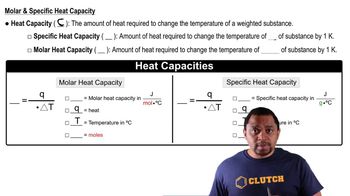
Specific heat capacity is the amount of heat required to raise the temperature of one gram of a substance by one degree Celsius. It varies for different materials and is crucial for calculating temperature changes when heat is absorbed or released. In this problem, knowing the specific heat capacity of Pyrex glass allows us to relate the heat absorbed to the change in temperature and ultimately find the mass.
추천 영상:
가이드 코스
Heat Capacity
Heat Transfer Equation
The heat transfer equation, often expressed as Q = mcΔT, relates the heat absorbed or released (Q) to the mass (m), specific heat capacity (c), and the change in temperature (ΔT). This equation is fundamental in thermodynamics and is used to solve for unknown variables, such as mass, when heat transfer is involved. In this case, it will help determine the mass of the Pyrex glass based on the heat absorbed and the temperature change.
추천 영상:
가이드 코스
Heat Capacity
Temperature Change
Temperature change (ΔT) is the difference between the final temperature (Tf) and the initial temperature (Ti) of a substance. It is a critical factor in thermodynamic calculations, as it directly influences the amount of heat absorbed or released. In this scenario, the temperature change of the Pyrex glass from 23.0 °C to 55.4 °C is essential for applying the heat transfer equation to find the mass of the substance.
추천 영상:
가이드 코스
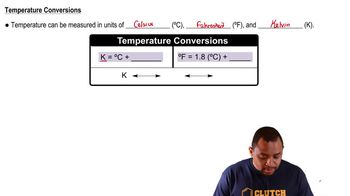
Temperature Conversion Formulas
관련 실천
교과서 질문
2037
views
교과서 질문
The air within a piston equipped with a cylinder absorbs 565 J of heat and expands from an initial volume of 0.10 L to a final volume of 0.85 L against an external pressure of 1.0 atm. What is the change in internal energy of the air within the piston?
3726
views
2
rank
교과서 질문
How much heat is required to warm 2.50 L of water from 25.0 °C to 100.0 °C? (Assume a density of 1.0 g/mL for the water.)
1
views
교과서 질문
How much heat is required to warm 2.50 kg of sand from 25.0 °C to 100.0 °C?
1
views
교과서 질문
How much work (in J) is required to expand the volume of a pump from 0.0 L to 2.5 L against an external pressure of 1.1 atm?
1630
views
교과서 질문
Suppose that 25 g of each substance is initially at 27.0 °C. What is the final temperature of each substance upon absorbing 2.35 kJ of heat? c. aluminum
2959
views