
Ch.7 - Thermochemistry
Tro - Chemistry: A Molecular Approach 6th Edition
Tro6th EditionChemistry: A Molecular ApproachISBN: 9780137832217당신이 사용하는 게 아니라요?교과서 변경
7장, 문제 46

The air in an inflated balloon (defined as the system) warms over a toaster and absorbs 142 J of heat. As it expands, it does 46 kJ of work. What is the change in internal energy for the system?

검증된 단계별 안내
1
Identify the first law of thermodynamics, which states that the change in internal energy (\( \Delta U \)) of a system is equal to the heat added to the system (\( q \)) minus the work done by the system (\( w \)).
Express the first law of thermodynamics as an equation: \( \Delta U = q - w \).
Convert all units to be consistent. Note that the work done is given in kilojoules (kJ), so convert it to joules (J) by multiplying by 1000: \( 46 \text{ kJ} = 46000 \text{ J} \).
Substitute the given values into the equation: \( \Delta U = 142 \text{ J} - 46000 \text{ J} \).
Calculate \( \Delta U \) to find the change in internal energy of the system.

비슷한 문제에 대한 검증된 영상 답변:

이 영상 해법은 위 문제에 도움이 된다고 튜터들이 추천한 것입니다.
영상 길이:
1m
도움이 되었나요?

주요 개념

질문에 올바르게 답하기 위해 반드시 이해해야 하는 핵심 개념들은 다음과 같습니다.

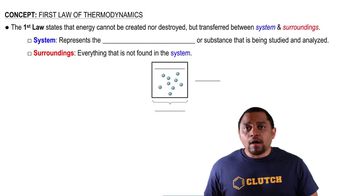
First Law of Thermodynamics

The First Law of Thermodynamics states that energy cannot be created or destroyed, only transformed. In a closed system, the change in internal energy is equal to the heat added to the system minus the work done by the system. This principle is fundamental for analyzing energy transfers in thermodynamic processes.
추천 영상:
가이드 코스
01:18
First Law of Thermodynamics

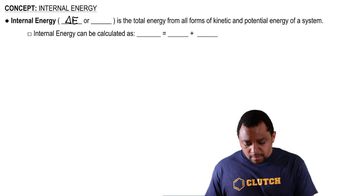
Internal Energy

Internal energy is the total energy contained within a system, including kinetic and potential energy of the particles. It is a state function, meaning it depends only on the current state of the system, not on how it reached that state. Changes in internal energy can be calculated using the First Law of Thermodynamics.
추천 영상:
가이드 코스
00:40
Internal Energy

Work and Heat Transfer

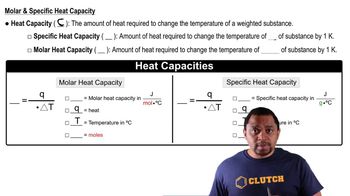
In thermodynamics, work refers to energy transfer that occurs when a force is applied over a distance, while heat is the energy transferred due to a temperature difference. Both work and heat are forms of energy transfer that affect the internal energy of a system. Understanding how these two forms of energy interact is crucial for solving thermodynamic problems.
추천 영상:
관련 실천
교과서 질문

A kilogram of aluminum metal and a kilogram of water are each warmed to 75 °C and placed in two identical insulated containers. One hour later, the two containers are opened and the temperature of each substance is measured. The aluminum has cooled to 35 °C, while the water has cooled only to 66 °C. Explain this difference.

1214
views
교과서 질문

Identify each energy exchange as primarily heat or work and determine whether the sign of ΔE is positive or negative for the system. Identify each energy exchange as primarily heat or work. a. A rolling billiard ball collides with another billiard ball. The first billiard ball (defined as the system) stops rolling after the collision. b. A book falls to the floor. (The book is the system). c. A father pushes his daughter on a swing. (The daughter and the swing are the system). Identify each energy exchange as primarily heat or work.

916
views
교과서 질문

We pack two identical coolers for a picnic, placing 24 12-ounce soft drinks and five pounds of ice in each. However, the drinks that we put into cooler A were refrigerated for several hours before they were packed in the cooler, while the drinks that we put into cooler B were at room temperature. When we open the two coolers three hours later, most of the ice in cooler A is still present, while nearly all of the ice in cooler B has melted. Explain this difference.

1120
views
교과서 질문

A system releases 511 kJ of heat and does 125 kJ of work on the surroundings. What is the change in internal energy of the system?

2
views
교과서 질문

How much heat is required to warm 2.50 L of water from 25.0 °C to 100.0 °C? (Assume a density of 1.0 g/mL for the water.)

1
views
교과서 질문

A system absorbs 225 kJ of heat and the surroundings do 121 kJ of work on the system. What is the change in internal energy of the system?

1
views