
Ch.7 - Thermochemistry
Tro - Chemistry: A Molecular Approach 6th Edition
Tro6th EditionChemistry: A Molecular ApproachISBN: 9780137832217당신이 사용하는 게 아니라요?교과서 변경
7장, 문제 82

Consider the generic reaction:
A + 2 B → C + 3 D ΔH = 155 kJ
Determine the value of ΔH for each related reaction.
a. 3 A + 6 B → 3 C + 9 D
b. C + 3 D → A + 2 B
c. 1/2 C + 3/2 D → 1/2 A + B

검증된 단계별 안내
1
insert step 1> Identify the given reaction and its enthalpy change: A + 2B \(\rightarrow\) C + 3D with \(\Delta\) H = 155 \(\text{ kJ}\).
insert step 2> For reaction (a), 3A + 6B \(\rightarrow\) 3C + 9D, notice that the entire reaction is multiplied by 3. Therefore, multiply the \(\Delta\) H of the original reaction by 3.
insert step 3> For reaction (b), C + 3D \(\rightarrow\) A + 2B, observe that this is the reverse of the original reaction. To find \(\Delta\) H for the reverse reaction, change the sign of \(\Delta\) H from positive to negative.
insert step 4> For reaction (c), \(\frac{1}{2}\)C + \(\frac{3}{2}\)D \(\rightarrow\) \(\frac{1}{2}\)A + B, note that the original reaction is halved. Therefore, divide the \(\Delta\) H of the original reaction by 2.
insert step 5> Apply these transformations to the \(\Delta\) H value of the original reaction to find the \(\Delta\) H for each related reaction.

비슷한 문제에 대한 검증된 영상 답변:

이 영상 해법은 위 문제에 도움이 된다고 튜터들이 추천한 것입니다.
영상 길이:
2m
도움이 되었나요?

주요 개념

질문에 올바르게 답하기 위해 반드시 이해해야 하는 핵심 개념들은 다음과 같습니다.

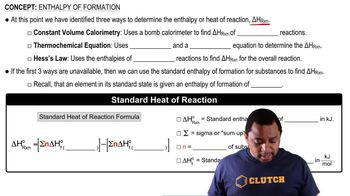
Enthalpy Change (ΔH)

Enthalpy change (ΔH) is a measure of the heat absorbed or released during a chemical reaction at constant pressure. It indicates whether a reaction is exothermic (releases heat, ΔH < 0) or endothermic (absorbs heat, ΔH > 0). In this question, the given ΔH of 155 kJ represents the energy change for the reaction as written, which is crucial for calculating ΔH for related reactions.
추천 영상:
가이드 코스
02:34
Enthalpy of Formation

Stoichiometry

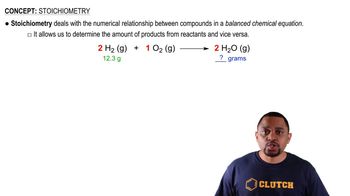
Stoichiometry involves the quantitative relationships between the reactants and products in a chemical reaction. It allows us to determine how changes in the coefficients of a balanced equation affect the overall enthalpy change. For example, if the coefficients are multiplied by a factor, the ΔH value must also be multiplied by the same factor to maintain the relationship between the amounts of substances involved.
추천 영상:
가이드 코스
01:16
Stoichiometry Concept

Reverse Reactions

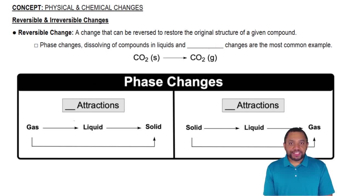
The enthalpy change for a reverse reaction is equal in magnitude but opposite in sign to that of the forward reaction. This principle is essential when calculating ΔH for reactions that are the reverse of the original reaction. Understanding this concept helps in determining the enthalpy changes for reactions that involve the same substances but in different arrangements or directions.
추천 영상:
가이드 코스
03:42
Reversible Changes in Matter