
Ch.7 - Thermochemistry
Tro - Chemistry: A Molecular Approach 6th Edition
Tro6th EditionChemistry: A Molecular ApproachISBN: 9780137832217당신이 사용하는 게 아니라요?교과서 변경
7장, 문제 92d

Use standard enthalpies of formation to calculate ΔH°rxn for each reaction. d. N2O4(g) + 4 H2(g) → N2(g) + 4 H2O(g)

검증된 단계별 안내
1
Identify the standard enthalpy of formation (ΔH°f) for each reactant and product in the reaction. These values are typically found in tables in chemistry textbooks or reliable online resources.
Write the balanced chemical equation: N₂O₄(g) + 4 H₂(g) → N₂(g) + 4 H₂O(g).
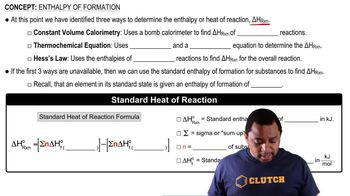
Apply the formula for the standard enthalpy change of the reaction: ΔH°rxn = Σ(ΔH°f of products) - Σ(ΔH°f of reactants).
Calculate the sum of the standard enthalpies of formation for the products: [ΔH°f(N₂(g)) + 4 * ΔH°f(H₂O(g))].
Calculate the sum of the standard enthalpies of formation for the reactants: [ΔH°f(N₂O₄(g)) + 4 * ΔH°f(H₂(g))]. Subtract the sum of the reactants from the sum of the products to find ΔH°rxn.

비슷한 문제에 대한 검증된 영상 답변:

이 영상 해법은 위 문제에 도움이 된다고 튜터들이 추천한 것입니다.
영상 길이:
2m

주요 개념

질문에 올바르게 답하기 위해 반드시 이해해야 하는 핵심 개념들은 다음과 같습니다.

Enthalpy of Formation

The standard enthalpy of formation (ΔH°f) is the change in enthalpy when one mole of a compound is formed from its elements in their standard states. It is a crucial value used in thermodynamics to calculate the heat changes in chemical reactions. Each substance has a specific ΔH°f, which can be found in tables, and is essential for determining the overall enthalpy change of a reaction.
추천 영상:
가이드 코스
02:34
Enthalpy of Formation

Hess's Law

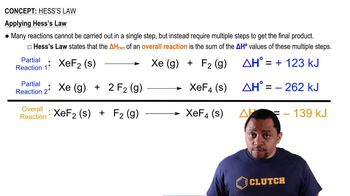
Hess's Law states that the total enthalpy change for a reaction is the same, regardless of the number of steps taken to achieve the reaction. This principle allows chemists to calculate the enthalpy change of a reaction by summing the enthalpy changes of individual steps, making it possible to use standard enthalpies of formation to find ΔH°rxn for complex reactions.
추천 영상:

Reaction Enthalpy Change (ΔH°rxn)

The reaction enthalpy change (ΔH°rxn) is the difference between the total enthalpy of the products and the total enthalpy of the reactants. It indicates whether a reaction is exothermic (releases heat, ΔH°rxn < 0) or endothermic (absorbs heat, ΔH°rxn > 0). Calculating ΔH°rxn using standard enthalpies of formation involves subtracting the sum of the ΔH°f values of the reactants from that of the products.
추천 영상:
가이드 코스
02:34
Enthalpy of Formation