Ch.8 - The Quantum-Mechanical Model of the Atom
Tro - Chemistry: A Molecular Approach 6th Edition
Tro6th EditionChemistry: A Molecular ApproachISBN: 9780137832217당신이 사용하는 게 아니라요?교과서 변경
8장, 문제 98

A 5.00-mL ampule of a 0.100-M solution of naphthalene in hexane is excited with a flash of light. The naphthalene emits 12.3 J of energy at an average wavelength of 349 nm. What percentage of the naphthalene molecules emitted a photon?

검증된 단계별 안내
1
Calculate the energy of a single photon using the formula: \( E = \frac{hc}{\lambda} \), where \( h \) is Planck's constant \( 6.626 \times 10^{-34} \text{ J s} \), \( c \) is the speed of light \( 3.00 \times 10^8 \text{ m/s} \), and \( \lambda \) is the wavelength in meters.
Convert the wavelength from nanometers to meters by dividing by \( 10^9 \).
Determine the total number of photons emitted by dividing the total energy emitted (12.3 J) by the energy of a single photon calculated in step 1.
Calculate the total number of naphthalene molecules in the solution using the formula: \( \text{moles} = M \times V \), where \( M \) is the molarity (0.100 M) and \( V \) is the volume in liters (5.00 mL converted to liters). Then multiply by Avogadro's number \( 6.022 \times 10^{23} \text{ molecules/mol} \).
Calculate the percentage of naphthalene molecules that emitted a photon by dividing the number of photons emitted by the total number of naphthalene molecules, and then multiply by 100 to get the percentage.

비슷한 문제에 대한 검증된 영상 답변:

이 영상 해법은 위 문제에 도움이 된다고 튜터들이 추천한 것입니다.
영상 길이:
6m

주요 개념

질문에 올바르게 답하기 위해 반드시 이해해야 하는 핵심 개념들은 다음과 같습니다.

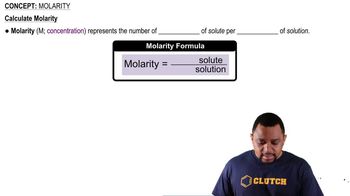
Molarity and Solution Concentration

Molarity (M) is a measure of concentration defined as the number of moles of solute per liter of solution. In this question, the naphthalene solution has a concentration of 0.100 M, meaning there are 0.100 moles of naphthalene in one liter of hexane. Understanding molarity is essential for calculating the total number of naphthalene molecules present in the given volume of solution.
추천 영상:
가이드 코스
00:53
Molarity Concept

Photon Emission and Energy

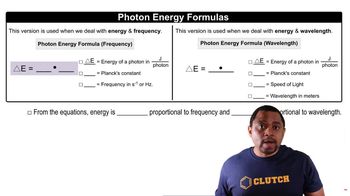
When a molecule absorbs energy, it can become excited and subsequently release energy in the form of a photon when it returns to a lower energy state. The energy of the emitted photon can be calculated using the equation E = hc/λ, where E is energy, h is Planck's constant, c is the speed of light, and λ is the wavelength. This concept is crucial for determining how many molecules emitted photons based on the total energy released.
추천 영상:
가이드 코스
01:40
Photon Energy Formulas

Percentage Calculation

To find the percentage of naphthalene molecules that emitted a photon, one must compare the number of molecules that emitted photons to the total number of naphthalene molecules present in the solution. This involves calculating the total number of molecules using Avogadro's number and then using the formula: (number of emitting molecules / total number of molecules) × 100%. This concept is fundamental for expressing the result as a percentage.
추천 영상:
가이드 코스
02:28
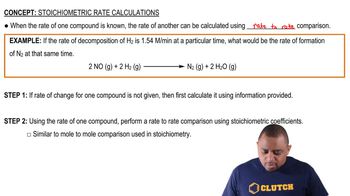
Stoichiometric Rate Calculations