Skip to main content
Genetics
나의 코스
배우기
시험 준비
AI 튜터
학습 가이드
교과서적 해결책
플래시카드
탐험해 보세요
앱을 사용해 보세요
나의 코스
배우기
시험 준비
AI 튜터
학습 가이드
교과서적 해결책
플래시카드
탐험해 보세요
앱을 사용해 보세요
뒤로
Bacterial Transformation definitions
카드를 뒤집기 위해 탭할 수 있습니다.
Transformation
카드를 뒤집기 위해 탭할 수 있습니다.
👆
Transformation
Uptake of external genetic material by bacteria, enabling new traits or functions, often used in laboratory gene studies.
진행 상황 추적
컨트롤 버튼이 '내비게이션' 모드로 변경되었습니다.
1/15
관련 플래시카드
관련 실천
추천 영상
Bacterial Transformation quiz #1
Bacterial Transformation
10 용어
Bacterial Transformation
5. Genetics of Bacteria and Viruses
7 문제점
주제
Kylia
Bacteriophage Genetics
5. Genetics of Bacteria and Viruses
7 문제점
주제
Kylia
5. Genetics of Bacteria and Viruses
5 주제
13 문제점
장
Kylia
VideoThumbView.guidedCourse
05:48
Transformation
1500
views
10
rank
이 집합의 용어 (15)
하이드의 정의
Transformation
Uptake of external genetic material by bacteria, enabling new traits or functions, often used in laboratory gene studies.
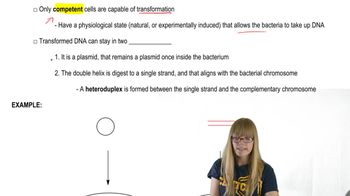
Competent Cells
Bacterial cells in a physiological state that allows them to absorb external DNA through their membrane.
Plasmid
Circular DNA molecule commonly used in experiments for gene expression and protein production in bacteria.
Heteroduplex
DNA structure formed when a single strand aligns with a complementary region on the bacterial chromosome after transformation.
Gene Mapping
Technique using DNA uptake patterns to determine the relative positions of genes on a chromosome.
Fragmented DNA
Pieces of genetic material produced by breaking DNA, used to study gene proximity during transformation.
Double Transformation
Simultaneous uptake of two genes by a bacterium, indicating their close proximity on the original DNA.
Bacterial Membrane
Barrier that external DNA must cross for successful genetic uptake during transformation.
Physiological State
Condition of bacteria, natural or induced, that enables DNA absorption from the environment.
Lysis
Process where a bacterial cell bursts, releasing its DNA into the environment for potential uptake.
Experimental Technique
Laboratory method involving manipulation of bacteria and DNA to study genetic functions or produce proteins.
Chromosome
Large DNA molecule in bacteria where foreign DNA fragments can integrate during transformation.
Complementary Region
Segment of bacterial DNA with a sequence similar enough to align with incoming single-stranded DNA.
Protein Production
Outcome of introducing specific genes into bacteria, leading to synthesis of desired proteins.
Enzyme
Molecule used to fragment DNA, facilitating gene mapping and transformation studies.
 뒤로뒤로
뒤로뒤로
 05:48
05:48