Skip to main content
Genetics
나의 코스
배우기
시험 준비
AI 튜터
학습 가이드
교과서적 해결책
플래시카드
탐험해 보세요
앱을 사용해 보세요
나의 코스
배우기
시험 준비
AI 튜터
학습 가이드
교과서적 해결책
플래시카드
탐험해 보세요
앱을 사용해 보세요
뒤로
Chromosomal Rearrangements: Inversions quiz
카드를 뒤집기 위해 탭할 수 있습니다.
What is a chromosomal inversion?
카드를 뒤집기 위해 탭할 수 있습니다.
👆
What is a chromosomal inversion?
A chromosomal inversion is when a segment of a chromosome is reversed in orientation, but the overall genetic content remains the same.
진행 상황 추적
컨트롤 버튼이 '내비게이션' 모드로 변경되었습니다.
1/15
관련 플래시카드
관련 실천
추천 영상
Chromosomal Rearrangements: Inversions definitions
Chromosomal Rearrangements: Inversions
13 용어
Chromosomal Rearrangements: Inversions
6. Chromosomal Variation
6 문제점
주제
Kylia
Chromosomal Rearrangements: Translocations
6. Chromosomal Variation
6 문제점
주제
Kylia
6. Chromosomal Variation - Part 1 of 2
5 주제
10 문제점
장
Kylia
6. Chromosomal Variation - Part 2 of 2
3 주제
10 문제점
장
Kylia
VideoThumbView.guidedCourse
05:15
Inversions
1788
views
10
rank
이 집합의 용어 (15)
하이드의 정의
What is a chromosomal inversion?
A chromosomal inversion is when a segment of a chromosome is reversed in orientation, but the overall genetic content remains the same.
What are the two main types of chromosomal inversions?
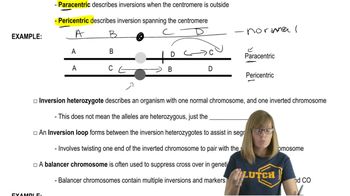
The two main types are paracentric inversions (which do not include the centromere) and pericentric inversions (which include the centromere).
What distinguishes a paracentric inversion from a pericentric inversion?
A paracentric inversion does not involve the centromere, while a pericentric inversion includes the centromere in the inverted segment.
What is an inversion heterozygote?
An inversion heterozygote is an individual with one normal chromosome and one chromosome with an inversion, either paracentric or pericentric.
Does an inversion heterozygote refer to alleles or chromosomes?
It refers to chromosomes, not alleles; the alleles can be homozygous even if the chromosomes are heterozygous for the inversion.
How does an inversion loop form?
An inversion loop forms when a segment of a chromosome twists and pairs with its uninverted counterpart, allowing the segment to flip orientation.
Why do scientists use balancer chromosomes?
Scientists use balancer chromosomes to suppress crossing over, allowing them to study genes or chromosomes without recombination.
What feature do balancer chromosomes have to prevent crossing over?
Balancer chromosomes contain multiple inversions, which suppress recombination during meiosis.
If a chromosome segment ABCD undergoes a paracentric inversion involving CD, what is the new order?
The new order would be ABDC, with the centromere not included in the inversion.
If a chromosome segment ABCD undergoes a pericentric inversion involving BC, what is the new order?
The new order would be ACBD, with the centromere included in the inverted segment.
What does the term 'inversion' specifically refer to in genetics?
It refers to the reversal of the orientation of a segment within a chromosome.
Can all alleles be homozygous in an inversion heterozygote?
Yes, all alleles can be homozygous even if the chromosomes are heterozygous for the inversion.
What is the main purpose of using balancer chromosomes in genetic studies?
The main purpose is to prevent crossing over, ensuring genetic stability for experimental studies.
What does the formation of an inversion loop facilitate?
It facilitates the flipping of a chromosome segment, leading to the inversion.
Why is it important not to confuse inversion heterozygosity with allele heterozygosity?
Because inversion heterozygosity refers to chromosome structure, not to the presence of different alleles at a gene locus.
 뒤로뒤로
뒤로뒤로
 05:15
05:15