Skip to main content
Genetics
나의 코스
배우기
시험 준비
AI 튜터
학습 가이드
교과서적 해결책
플래시카드
탐험해 보세요
앱을 사용해 보세요
나의 코스
배우기
시험 준비
AI 튜터
학습 가이드
교과서적 해결책
플래시카드
탐험해 보세요
앱을 사용해 보세요
뒤로
Chromosomal Rearrangements: Translocations definitions
카드를 뒤집기 위해 탭할 수 있습니다.
Translocation
카드를 뒤집기 위해 탭할 수 있습니다.
👆
Translocation
Movement of a chromosomal segment to a different chromosome, altering gene arrangement and inheritance patterns.
진행 상황 추적
컨트롤 버튼이 '내비게이션' 모드로 변경되었습니다.
1/15
관련 플래시카드
관련 실천
추천 영상
Chromosomal Rearrangements: Translocations quiz #1
Chromosomal Rearrangements: Translocations
10 용어
Chromosomal Rearrangements: Translocations
6. Chromosomal Variation
6 문제점
주제
Kylia
Chromosomal Rearrangements: Inversions
6. Chromosomal Variation
6 문제점
주제
Kylia
6. Chromosomal Variation - Part 1 of 2
5 주제
10 문제점
장
Kylia
6. Chromosomal Variation - Part 2 of 2
3 주제
10 문제점
장
Kylia
VideoThumbView.guidedCourse
12:42
Reciprocal Translocation
2264
views
12
rank
2
comments
VideoThumbView.guidedCourse
09:31
Robertsonian Translocations
1807
views
11
rank
1
comments
이 집합의 용어 (15)
하이드의 정의
Translocation
Movement of a chromosomal segment to a different chromosome, altering gene arrangement and inheritance patterns.
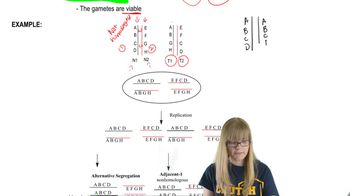
Reciprocal Translocation
Exchange of acentric fragments between two non-homologous chromosomes, leading to complex segregation during meiosis.
Acentric Fragment
Chromosomal piece lacking a centromere, often involved in exchanges during certain chromosomal rearrangements.
Adjacent-1 Segregation
Meiotic outcome where non-homologous chromosomes segregate together, producing non-viable gametes due to incomplete gene sets.
Adjacent-2 Segregation
Meiotic outcome where homologous chromosomes segregate together, also resulting in non-viable gametes lacking full genetic content.
Alternative Segregation
Meiotic outcome where either all normal or all translocated chromosomes segregate together, yielding viable gametes with complete genes.
Homologous Chromosome
Chromosome pair containing the same genes, which align during meiosis and influence segregation outcomes.
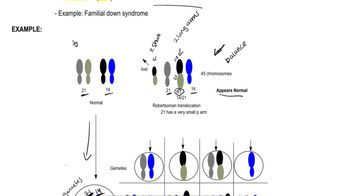
Robertsonian Translocation
Fusion of two long arms from non-homologous acrocentric chromosomes, often resulting in a single chromosome and loss of short arms.
Acrocentric Chromosome
Chromosome with a centromere near one end, producing a very short arm and a much longer arm.
Balanced Translocation
Chromosomal rearrangement where all genetic material is present, though rearranged, typically causing no phenotypic effect.
Unbalanced Translocation
Chromosomal rearrangement resulting in extra or missing genetic material, often leading to disorders or non-viable offspring.
Familial Down Syndrome
Genetic condition caused by inheritance of a Robertsonian translocation involving chromosome 21, leading to trisomy 21.
Trisomy 21
Presence of three copies of chromosome 21, resulting in Down syndrome, which can arise from chromosomal rearrangements.
Gamete Segregation
Distribution of chromosomes into reproductive cells during meiosis, determining genetic outcomes in offspring.
Chromosomal Aberration
Structural alteration in chromosomes, such as translocations, that can impact gene dosage and inheritance.
 뒤로뒤로
뒤로뒤로
 12:42
12:42