Skip to main content
Genetics
나의 코스
배우기
시험 준비
AI 튜터
학습 가이드
교과서적 해결책
플래시카드
탐험해 보세요
앱을 사용해 보세요
나의 코스
배우기
시험 준비
AI 튜터
학습 가이드
교과서적 해결책
플래시카드
탐험해 보세요
앱을 사용해 보세요
뒤로
History of Genetics definitions
카드를 뒤집기 위해 탭할 수 있습니다.
Domestication
카드를 뒤집기 위해 탭할 수 있습니다.
👆
Domestication
Early process where humans shaped animal and plant traits by choosing which individuals reproduced, laying groundwork for genetic understanding.
진행 상황 추적
컨트롤 버튼이 '내비게이션' 모드로 변경되었습니다.
1/15
관련 플래시카드
관련 실천
추천 영상
History of Genetics quiz #1
History of Genetics
17 용어
History of Genetics
1. Introduction to Genetics
7 문제점
주제
Kylia
Modern Genetics
1. Introduction to Genetics
7 문제점
주제
Kylia
1. Introduction to Genetics
3 주제
9 문제점
장
Kylia
VideoThumbView.guidedCourse
11:35
History of Genetics
9252
views
225
rank
4
comments
이 집합의 용어 (15)
하이드의 정의
Domestication
Early process where humans shaped animal and plant traits by choosing which individuals reproduced, laying groundwork for genetic understanding.
Selective Breeding
Intentional mating of organisms with desired traits to enhance those traits in future generations, predating modern genetics.
Artificial Selection
Human-driven process of propagating specific traits in plants or animals, distinct from natural evolutionary forces.
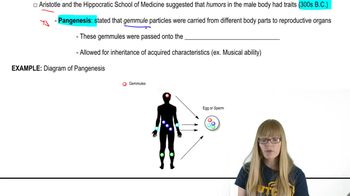
Pangenesis
Ancient theory proposing that particles from all body parts collect in reproductive organs and transmit traits to offspring.
Gemmules
Hypothetical particles thought to carry information from each body part to reproductive cells, influencing inherited traits.
Epigenesis
Concept that new organisms arise from substances in sex cells, suggesting development starts from undifferentiated material.
Preformation
Historical idea that sex cells contain a fully formed miniature organism, which simply grows during development.
Blending Theory
Disproven belief that offspring traits are a fluid mix of parental traits, like blending paint colors.
Genes
Discrete hereditary particles proposed to control inheritance, later identified as units of information on chromosomes.
Alleles
Different versions of hereditary particles, with each individual carrying two, influencing trait expression.
Dominance
Phenomenon where one hereditary factor masks the effect of another, determining which trait is visible.
Chromosomes
Structures discovered to carry hereditary particles, serving as vehicles for gene transmission during inheritance.
Chromosomal Theory of Inheritance
Proposal that hereditary particles are located on specific cellular structures, explaining how traits are passed on.
Genetics
Field of science focused on understanding how traits are inherited and how hereditary information is transmitted.
Inheritance
Process by which traits and characteristics are passed from one generation to the next through hereditary material.
 뒤로뒤로
뒤로뒤로
 11:35
11:35