

The human genome contains approximately 106 copies of an Alu sequence, one of the best-studied classes of short interspersed elements (SINEs), per haploid genome. Individual Alu units share a 282-nucleotide consensus sequence followed by a 3'-adenine-rich tail region [Schmid (1998)]. Given that there are approximately 3 x 10⁹ base pairs per human haploid genome, about how many base pairs are spaced between each Alu sequence?
Ch. 11 - Chromosome Structure and DNA Sequence Organization
11장, 문제 19
The following is a diagram of the general structure of the bacteriophage chromosome. Speculate on the mechanism by which it forms a closed ring upon infection of the host cell.

검증된 단계별 안내1
Step 1: Identify the key features of the bacteriophage chromosome structure shown in the diagram, focusing on the double-stranded DNA region and the complementary single-stranded ends.
Step 2: Recognize that the complementary sequences at the ends of the linear DNA can base pair with each other, which is essential for forming a closed circular structure.
Step 3: Understand that upon infection, the single-stranded complementary ends can anneal through base pairing, bringing the two ends of the linear chromosome together.
Step 4: Consider the role of host or phage-encoded enzymes, such as DNA ligase, which can covalently join the sugar-phosphate backbones of the annealed ends, sealing the DNA into a closed circular ring.
Step 5: Summarize the mechanism as a process where complementary single-stranded ends hybridize to form a circular intermediate, followed by enzymatic ligation to create a stable closed ring chromosome inside the host cell.

비슷한 문제에 대한 검증된 영상 답변:
이 영상 해법은 위 문제에 도움이 된다고 튜터들이 추천한 것입니다.
영상 길이:
1m도움이 되었나요?
주요 개념
질문에 올바르게 답하기 위해 반드시 이해해야 하는 핵심 개념들은 다음과 같습니다.
Bacteriophage Chromosome Structure
Bacteriophage chromosomes often consist of double-stranded DNA with specific sequences that can interact to form unique structures. Understanding the arrangement of complementary sequences and double-stranded regions is essential to grasp how the DNA can circularize or form closed rings upon infection.
추천 영상:
가이드 코스
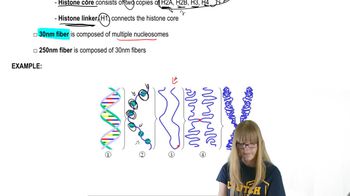
Chromosome Structure
DNA Complementarity and Base Pairing
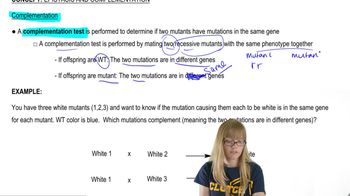
DNA strands are complementary, meaning bases on one strand pair specifically with bases on the opposite strand (A with T, G with C). This complementarity allows single-stranded regions or sticky ends to anneal, facilitating the formation of circular DNA molecules through base pairing.
추천 영상:
가이드 코스
Complementation
Mechanism of DNA Circularization in Phages
Upon infection, linear phage DNA can circularize by annealing complementary single-stranded ends or through enzymatic ligation. This closed ring formation protects the DNA from degradation and is critical for replication and integration within the host.
추천 영상:
가이드 코스
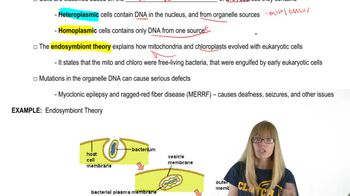
Organelle DNA Characteristics
관련 실천
교과서 질문
725
views
교과서 질문
How many base pairs are in a molecule of phage T2 DNA 52-µm long?
838
views
교과서 질문
Assume that a viral DNA molecule is a 50-µm-long circular strand with a uniform 20-Å diameter. If this molecule is contained in a viral head that is a 0.08-µm-diameter sphere, will the DNA molecule fit into the viral head, assuming complete flexibility of the molecule? Justify your answer mathematically.
472
views
