Ch. 13 - Translation and Proteins
Klug - Essentials of Genetics 10th Edition
Klug10th EditionEssentials of GeneticsISBN: 9780135588789당신이 사용하는 게 아니라요?교과서 변경
13장, 문제 11

Hemoglobin is a tetramer consisting of two α and two β chains. What level of protein structure is described in this statement?

검증된 단계별 안내
1
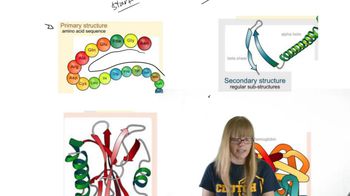
Identify the four levels of protein structure: primary, secondary, tertiary, and quaternary.
Recall that the primary structure refers to the linear sequence of amino acids in a single polypeptide chain.
Understand that the secondary structure involves local folding patterns such as alpha helices and beta sheets within a single chain.
Recognize that the tertiary structure is the overall three-dimensional shape of a single polypeptide chain.
Note that the quaternary structure describes the assembly of multiple polypeptide chains (subunits) into a functional protein complex, such as hemoglobin's two α and two β chains.

주요 개념

질문에 올바르게 답하기 위해 반드시 이해해야 하는 핵심 개념들은 다음과 같습니다.

Protein Structure Levels

Proteins have four structural levels: primary (amino acid sequence), secondary (local folding like alpha-helices and beta-sheets), tertiary (3D folding of a single polypeptide), and quaternary (assembly of multiple polypeptide chains). Understanding these levels helps identify the organization described in a protein.
추천 영상:

Quaternary Structure

Quaternary structure refers to the arrangement and interaction of multiple polypeptide chains (subunits) in a multi-subunit protein. Hemoglobin’s composition of two α and two β chains exemplifies quaternary structure, where separate polypeptides form a functional complex.
추천 영상:
가이드 코스
03:49
Ribosome Structure

Hemoglobin Structure

Hemoglobin is a classic example of a protein with quaternary structure, composed of four subunits: two alpha and two beta globin chains. This multi-subunit arrangement allows cooperative oxygen binding, illustrating the functional importance of quaternary structure.
추천 영상:
가이드 코스
03:49
Ribosome Structure