Ch. 13 - Translation and Proteins
Klug - Essentials of Genetics 10th Edition
Klug10th EditionEssentials of GeneticsISBN: 9780135588789당신이 사용하는 게 아니라요?교과서 변경
13장, 문제 21

How would the results vary in cross (a) of Problem 32 if genes A and B were linked with no crossing over between them? How would the results of cross (a) vary if genes A and B were linked and 20 map units (mu) apart?

검증된 단계별 안내
1
First, identify the original cross (a) from Problem 32 and determine the expected genotypic and phenotypic ratios assuming independent assortment (i.e., genes A and B are unlinked). This will serve as the baseline for comparison.
Next, consider the scenario where genes A and B are completely linked with no crossing over. In this case, the alleles on the same chromosome are inherited together as a single unit. Therefore, only parental gametes are produced, and recombinant gametes are absent. This will alter the expected offspring ratios compared to independent assortment.
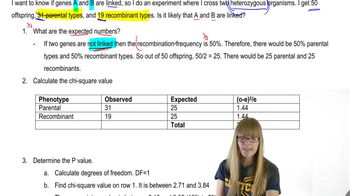
Then, analyze the case where genes A and B are linked but 20 map units apart. Since 1 map unit corresponds to a 1% recombination frequency, a distance of 20 map units means there is a 20% chance of crossing over between the genes. Calculate the expected frequencies of parental and recombinant gametes using the recombination frequency: parental gametes will be produced at 80% combined frequency, and recombinant gametes at 20% combined frequency.
Use these gamete frequencies to determine the expected genotypic and phenotypic ratios in the offspring for the 20 map unit scenario. This will show intermediate results between complete linkage (no recombination) and independent assortment (50% recombination).
Finally, compare all three scenarios—independent assortment, complete linkage, and linkage with 20 map units—to understand how linkage and recombination frequency affect the genetic outcomes of the cross.

비슷한 문제에 대한 검증된 영상 답변:

이 영상 해법은 위 문제에 도움이 된다고 튜터들이 추천한 것입니다.
영상 길이:
1m

주요 개념

질문에 올바르게 답하기 위해 반드시 이해해야 하는 핵심 개념들은 다음과 같습니다.

Genetic Linkage

Genetic linkage occurs when two genes are located close together on the same chromosome and tend to be inherited together. This reduces the likelihood of independent assortment, causing parental allele combinations to appear more frequently than recombinant types in offspring.
추천 영상:
가이드 코스
07:33
Chi Square and Linkage

Crossing Over and Recombination Frequency

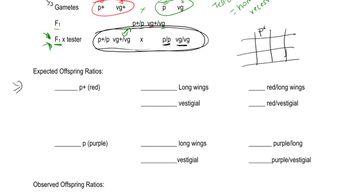
Crossing over is the exchange of genetic material between homologous chromosomes during meiosis, producing recombinant gametes. The recombination frequency, expressed in map units (mu), reflects the distance between genes; 1 mu corresponds to a 1% chance of crossover between two genes.
추천 영상:
가이드 코스
11:42
Morgan's Studies of Crossing Over

Effect of Linkage Distance on Genetic Cross Outcomes

When genes are completely linked with no crossing over, only parental gametes are produced, resulting in no recombinant offspring. If genes are linked but separated by 20 map units, crossing over occurs at a 20% frequency, producing both parental and recombinant offspring in predictable ratios.
추천 영상:
가이드 코스
03:38
Maternal Effect
관련 실천
교과서 질문

Three independently assorting genes (A, B, and C) are known to control the following biochemical pathway that provides the basis for flower color in a hypothetical plant:

Three homozygous recessive mutations are also known, each of which interrupts a different one of these steps. Determine the phenotypic results in the F1 and F2 generations resulting from the P1 crosses of true-breeding plants listed here:

speckled (AABBCC) × yellow (AAbbCC)

847
views
교과서 질문

Many antibiotics are effective as drugs to fight off bacterial infections because they inhibit protein synthesis in bacterial cells. Using the information provided in the following table that highlights several antibiotics and their mode of action, discuss which phase of translation is inhibited: initiation, elongation, or termination. What other components of the translational machinery could be targeted to inhibit bacterial protein synthesis?

847
views
교과서 질문

Three independently assorting genes (A, B, and C) are known to control the following biochemical pathway that provides the basis for flower color in a hypothetical plant:

Three homozygous recessive mutations are also known, each of which interrupts a different one of these steps. Determine the phenotypic results in the F1 and F2 generations resulting from the P1 crosses of true-breeding plants listed here:

colorless (aaBBCC) × green (AABBcc)

678
views
교과서 질문

Three independently assorting genes (A, B, and C) are known to control the following biochemical pathway that provides the basis for flower color in a hypothetical plant:

Three homozygous recessive mutations are also known, each of which interrupts a different one of these steps. Determine the phenotypic results in the F1 and F2 generations resulting from the P1 crosses of true-breeding plants listed here:

yellow (AAbbCC) × green (AABBcc)

531
views