Ch. 15 - Regulation of Gene Expression in Bacteria
Klug - Essentials of Genetics 10th Edition
Klug10th EditionEssentials of GeneticsISBN: 9780135588789당신이 사용하는 게 아니라요?교과서 변경
15장, 문제 13

What is the major difference between the mechanism involved in attenuation and riboswitches and the mechanism involved in the regulation of the lactose operon?

검증된 단계별 안내
1
Step 1: Understand the basic mechanisms involved in each regulatory system. Attenuation and riboswitches regulate gene expression primarily at the level of transcription termination or translation initiation by sensing small molecules or metabolites directly within the mRNA structure.
Step 2: Recognize that attenuation involves the formation of alternative secondary structures in the mRNA leader sequence, which can cause premature termination of transcription depending on the presence of specific amino acids or metabolites.
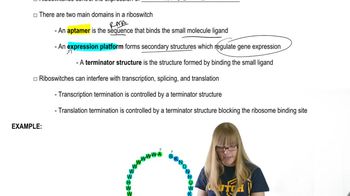
Step 3: Note that riboswitches are regulatory segments within the mRNA that bind small molecules directly, causing conformational changes that affect transcription termination or translation initiation without the need for protein factors.
Step 4: Contrast this with the lactose operon regulation, which primarily involves protein-mediated control. The lac operon is regulated by the lac repressor protein and the catabolite activator protein (CAP), which bind DNA to inhibit or activate transcription in response to lactose and glucose levels.
Step 5: Summarize the major difference: attenuation and riboswitches regulate gene expression through RNA structural changes in response to metabolites, while the lactose operon regulation relies on protein-DNA interactions to control transcription initiation.

주요 개념

질문에 올바르게 답하기 위해 반드시 이해해야 하는 핵심 개념들은 다음과 같습니다.

Attenuation and Riboswitch Mechanisms

Attenuation and riboswitches regulate gene expression at the transcriptional or translational level by sensing metabolite concentrations directly. Attenuation involves premature termination of transcription based on the formation of RNA secondary structures, while riboswitches alter mRNA conformation upon ligand binding to control gene expression.
추천 영상:

Lactose Operon Regulation

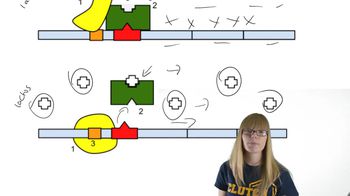
The lactose operon is regulated primarily through a repressor protein that binds to the operator region to block transcription in the absence of lactose. When lactose is present, it acts as an inducer by binding the repressor, causing it to release the operator and allowing transcription to proceed.
추천 영상:
가이드 코스
06:55
Lac Operon Regulation

Difference Between Direct Metabolite Sensing and Protein-Mediated Regulation

Attenuation and riboswitches directly sense metabolites via RNA structures without involving proteins, enabling rapid response. In contrast, the lactose operon regulation depends on protein-DNA interactions, where a repressor protein mediates gene expression changes indirectly through metabolite binding.
추천 영상:
관련 실천
교과서 질문

Predict the effect on the inducibility of the lac operon of a mutation that disrupts the function of:

(a) The CRP gene, which encodes the CAP protein

(b) The CAP-binding site within the promoter.

954
views
교과서 질문

Describe the role of attenuation in the regulation of tryptophan biosynthesis.

893
views
교과서 질문

A bacterial operon is responsible for the production of the biosynthetic enzymes needed to make the hypothetical amino acid tisophane (tis). The operon is regulated by a separate gene, R. The deletion of R causes the loss of enzyme synthesis. In the wild-type condition, when tis is present, no enzymes are made; in the absence of tis, the enzymes are made. Mutations in the operator gene (O⁻) result in repression regardless of the presence of tis. Is the operon under positive or negative control? Propose a model for:

(a) Repression of the genes in the presence of tis in wild-type cells

(b) The mutations.

1011
views
교과서 질문

Erythritol, a natural sugar abundant in fruits and fermenting foods, is about 65 percent as sweet as table sugar and has about 95 percent fewer calories. It is 'tooth friendly' and generally devoid of negative side effects as a human consumable product. Pathogenic Brucella strains that catabolize erythritol contain four closely spaced genes, all involved in erythritol metabolism. One of the four genes (eryD) encodes a product that represses the expression of the other three genes. Erythritol catabolism is stimulated by erythritol. Present a simple regulatory model to account for the regulation of erythritol catabolism in Brucella. Does this system appear to be under inducible or repressible control?

556
views