Ch. 16 - Regulation of Gene Expression in Eukaryotes

Klug10th EditionEssentials of GeneticsISBN: 9780135588789
당신이 사용하는 게 아니라요?교과서 변경다른 교과서를 선택하세요
TOC.tableOfContents
- Ch. 1 - Introduction to Genetics16
- Ch. 2 - Mitosis and Meiosis28
- Ch. 3 - Mendelian Genetics37
- Ch. 4 - Modification of Mendelian Ratios53
- Ch. 5 - Sex Determination and Sex Chromosomes32
- Ch. 6 - Chromosome Mutations: Variation in Number and Arrangement37
- Ch. 7 - Linkage and Chromosome Mapping in Eukaryotes36
- Ch. 8 - Genetic Analysis and Mapping in Bacteria and Bacteriophages24
- Ch. 9 - DNA Structure and Analysis38
- Ch. 10 - DNA Replication29
- Ch. 11 - Chromosome Structure and DNA Sequence Organization22
- Ch. 12 - The Genetic Code and Transcription36
- Ch. 13 - Translation and Proteins27
- Ch. 14 - Gene Mutation, DNA Repair, and Transposition34
- Ch. 15 - Regulation of Gene Expression in Bacteria22
- Ch. 16 - Regulation of Gene Expression in Eukaryotes37
- Ch. 17 - Recombinant DNA Technology27
- Ch. 18 - Genomics, Bioinformatics, and Proteomics30
- Ch. 19 - The Genetics of Cancer21
- Ch. 20 - Quantitative Genetics and Multifactorial Traits37
- Ch. 21 - Population and Evolutionary Genetics45

16장, 문제 22
Competing endogenous RNAs act as molecular “sponges.” What does this mean, and what do they compete with?
 검증된 단계별 안내
1
Understand that competing endogenous RNAs (ceRNAs) are RNA molecules that regulate gene expression by binding to microRNAs (miRNAs).
Recognize that miRNAs typically bind to messenger RNAs (mRNAs) to inhibit their translation or promote their degradation, thus reducing protein production.
Learn that ceRNAs act as molecular “sponges” by binding to these miRNAs, effectively sequestering them and preventing them from interacting with their target mRNAs.
Identify that the competition is between ceRNAs and mRNAs for binding to the same pool of miRNAs.
Conclude that by competing for miRNA binding, ceRNAs can indirectly increase the expression of mRNAs that would otherwise be suppressed by those miRNAs.
주요 개념
질문에 올바르게 답하기 위해 반드시 이해해야 하는 핵심 개념들은 다음과 같습니다.
Competing Endogenous RNAs (ceRNAs)
Competing endogenous RNAs are RNA molecules that regulate gene expression by binding and sequestering microRNAs (miRNAs). By acting as molecular 'sponges,' they reduce the availability of miRNAs to bind their usual target mRNAs, thereby modulating the repression of those target genes.
추천 영상:
가이드 코스
 05:43
05:43
RNA
MicroRNAs (miRNAs) and Gene Regulation
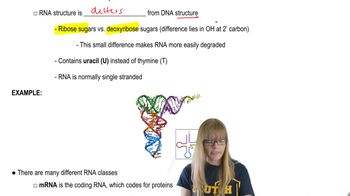
MicroRNAs are small non-coding RNAs that regulate gene expression post-transcriptionally by binding to complementary sequences on target mRNAs, leading to mRNA degradation or translational repression. Their activity is crucial for controlling protein levels in cells.
추천 영상:
가이드 코스
 06:38
06:38Regulation
Molecular Competition in RNA Networks
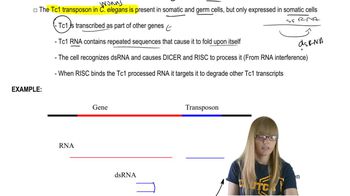
Molecular competition refers to the interaction where ceRNAs compete with mRNAs for binding to shared miRNAs. This competition influences the balance of gene expression by altering miRNA availability, creating a complex regulatory network among different RNA species.
추천 영상:
가이드 코스
05:43RNA
관련 실천