Ch. 16 - Regulation of Gene Expression in Eukaryotes
Klug10th EditionEssentials of GeneticsISBN: 9780135588789
당신이 사용하는 게 아니라요?교과서 변경다른 교과서를 선택하세요
TOC.tableOfContents
- Ch. 1 - Introduction to Genetics16
- Ch. 2 - Mitosis and Meiosis28
- Ch. 3 - Mendelian Genetics37
- Ch. 4 - Modification of Mendelian Ratios53
- Ch. 5 - Sex Determination and Sex Chromosomes32
- Ch. 6 - Chromosome Mutations: Variation in Number and Arrangement37
- Ch. 7 - Linkage and Chromosome Mapping in Eukaryotes36
- Ch. 8 - Genetic Analysis and Mapping in Bacteria and Bacteriophages24
- Ch. 9 - DNA Structure and Analysis38
- Ch. 10 - DNA Replication29
- Ch. 11 - Chromosome Structure and DNA Sequence Organization22
- Ch. 12 - The Genetic Code and Transcription36
- Ch. 13 - Translation and Proteins27
- Ch. 14 - Gene Mutation, DNA Repair, and Transposition34
- Ch. 15 - Regulation of Gene Expression in Bacteria22
- Ch. 16 - Regulation of Gene Expression in Eukaryotes37
- Ch. 17 - Recombinant DNA Technology27
- Ch. 18 - Genomics, Bioinformatics, and Proteomics30
- Ch. 19 - The Genetics of Cancer21
- Ch. 20 - Quantitative Genetics and Multifactorial Traits37
- Ch. 21 - Population and Evolutionary Genetics45

16장, 문제 25
How may the covalent modification of a protein with a phosphate group alter its function?
 검증된 단계별 안내
1
Understand that covalent modification refers to the addition or removal of chemical groups to a protein, which can change its structure and function.
Recognize that phosphorylation is the addition of a phosphate group (PO₄³⁻) to specific amino acid residues, commonly serine, threonine, or tyrosine, in the protein.
Consider how the addition of a negatively charged phosphate group can cause a conformational change in the protein's three-dimensional structure, potentially altering its activity.
Analyze how this conformational change can either activate or inhibit the protein's function, for example by changing its enzymatic activity, its ability to bind other molecules, or its localization within the cell.
Summarize that phosphorylation acts as a regulatory mechanism, allowing cells to control protein function dynamically in response to various signals.
주요 개념
질문에 올바르게 답하기 위해 반드시 이해해야 하는 핵심 개념들은 다음과 같습니다.
Protein Phosphorylation
Protein phosphorylation is the addition of a phosphate group to specific amino acids (usually serine, threonine, or tyrosine) in a protein. This covalent modification is catalyzed by enzymes called kinases and can change the protein's activity, interactions, or localization.
추천 영상:
가이드 코스
 05:05
05:05
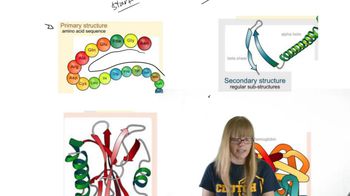
Proteins
Conformational Changes in Proteins
The addition of a phosphate group can induce conformational changes in a protein's structure. These changes can activate or inhibit the protein's function by altering its shape, which affects how it interacts with other molecules or substrates.
추천 영상:
가이드 코스
05:05Proteins
Regulation of Cellular Processes
Phosphorylation acts as a regulatory mechanism in cells, controlling processes like signal transduction, metabolism, and cell cycle progression. By modifying protein function, phosphorylation enables dynamic responses to internal and external signals.
추천 영상:
가이드 코스
 08:39
08:39mRNA Processing
관련 실천