Ch. 16 - Regulation of Gene Expression in Eukaryotes
Klug - Essentials of Genetics 10th Edition
Klug10th EditionEssentials of GeneticsISBN: 9780135588789당신이 사용하는 게 아니라요?교과서 변경
16장, 문제 6

Present an overview of the manner in which chromatin can be remodeled. Describe the manner in which these remodeling processes influence transcription.

검증된 단계별 안내
1
Begin by defining chromatin remodeling as the dynamic modification of chromatin architecture to allow access of condensed genomic DNA to the regulatory transcription machinery proteins, thereby controlling gene expression.
Explain the two main mechanisms of chromatin remodeling: (1) covalent modifications of histone proteins (such as acetylation, methylation, phosphorylation) and (2) ATP-dependent chromatin remodeling complexes that reposition or evict nucleosomes.
Describe how histone acetylation, typically carried out by histone acetyltransferases (HATs), neutralizes positive charges on histones, decreasing their affinity for DNA and resulting in a more open chromatin structure that facilitates transcription.
Discuss how ATP-dependent remodeling complexes use energy from ATP hydrolysis to slide nucleosomes along DNA, eject nucleosomes, or restructure nucleosome composition, thereby exposing promoter and enhancer regions to transcription factors and RNA polymerase.
Conclude by linking these remodeling processes to transcriptional regulation: open chromatin states generally promote transcription by allowing transcription factor binding, while closed or condensed chromatin states repress transcription by restricting access to DNA.

주요 개념

질문에 올바르게 답하기 위해 반드시 이해해야 하는 핵심 개념들은 다음과 같습니다.

Chromatin Structure and Organization

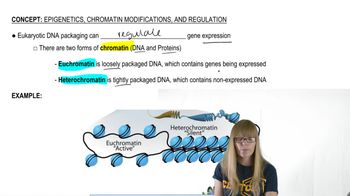
Chromatin is composed of DNA wrapped around histone proteins forming nucleosomes, which further fold into higher-order structures. Its organization regulates DNA accessibility, influencing gene expression by controlling how tightly or loosely DNA is packed.
추천 영상:

Mechanisms of Chromatin Remodeling

Chromatin remodeling involves ATP-dependent complexes that reposition, eject, or restructure nucleosomes to alter DNA accessibility. These changes enable or restrict the binding of transcription factors and RNA polymerase to DNA, thereby regulating gene activity.
추천 영상:

Impact of Chromatin Remodeling on Transcription

By modifying chromatin structure, remodeling processes either facilitate or hinder transcription initiation and elongation. Open chromatin states promote transcription by allowing factor binding, while closed states repress gene expression by limiting access to DNA.
추천 영상: