
Ch. 17 - Recombinant DNA Technology
Klug - Essentials of Genetics 10th Edition
Klug10th EditionEssentials of GeneticsISBN: 9780135588789당신이 사용하는 게 아니라요?교과서 변경
17장, 문제 24

What is the difference between nonhomologous end-joining (NHEJ) and homology-directed repair (HDR) in the context of genome editing?

검증된 단계별 안내
1
Step 1: Understand that both nonhomologous end-joining (NHEJ) and homology-directed repair (HDR) are cellular mechanisms used to repair double-strand breaks (DSBs) in DNA, which are critical in genome editing techniques like CRISPR-Cas9.
Step 2: Recognize that NHEJ repairs DSBs by directly ligating the broken DNA ends together without the need for a homologous template, which can lead to insertions or deletions (indels) at the repair site.
Step 3: Note that HDR requires a homologous DNA sequence as a template to accurately repair the break, allowing precise insertion or correction of genetic material during genome editing.
Step 4: Compare the outcomes: NHEJ is faster but error-prone, often resulting in mutations, while HDR is slower but more accurate, enabling precise gene modifications.
Step 5: Summarize that in genome editing, NHEJ is typically used for gene disruption by creating indels, whereas HDR is used for precise gene correction or insertion using a donor template.

주요 개념

질문에 올바르게 답하기 위해 반드시 이해해야 하는 핵심 개념들은 다음과 같습니다.

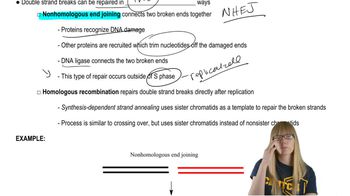
Nonhomologous End-Joining (NHEJ)

NHEJ is a DNA repair mechanism that directly ligates broken DNA ends without using a homologous template. It is quick but error-prone, often causing insertions or deletions at the break site. NHEJ is commonly exploited in genome editing to create gene knockouts by disrupting gene sequences.
추천 영상:
가이드 코스
03:03
Double Strand Breaks

Homology-Directed Repair (HDR)

HDR is a precise DNA repair process that uses a homologous DNA template to accurately repair double-strand breaks. In genome editing, HDR enables the introduction of specific genetic changes or insertions by providing a donor template with desired sequences. HDR is less efficient and typically occurs during the S and G2 phases of the cell cycle.
추천 영상:
가이드 코스
05:44
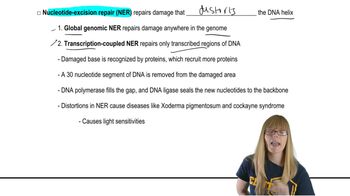
Repair Pathways

Genome Editing Context

Genome editing involves creating targeted DNA breaks to modify genetic information. Understanding the choice between NHEJ and HDR is crucial because NHEJ leads to gene disruption, while HDR allows precise gene correction or insertion. The repair pathway used affects the outcome and efficiency of genome editing techniques like CRISPR-Cas9.
추천 영상:
가이드 코스
02:48
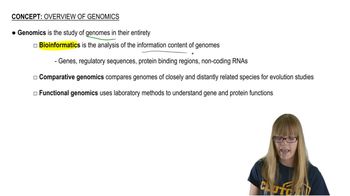
Genomics Overview