Ch. 20 - Quantitative Genetics and Multifactorial Traits
Klug - Essentials of Genetics 10th Edition
Klug10th EditionEssentials of GeneticsISBN: 9780135588789당신이 사용하는 게 아니라요?교과서 변경
20장, 문제 3

Define the following:
(a) Polygenic
(b) Additive alleles
(c) Correlation
(d) Monozygotic and dizygotic twins
(e) Heritability
(f) QTL
(g) Continuous variation

검증된 단계별 안내
1
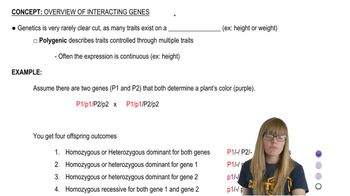
Define (a) Polygenic: Explain that polygenic traits are controlled by multiple genes, each contributing a small effect to the overall phenotype, resulting in continuous variation rather than discrete categories.
Define (b) Additive alleles: Describe additive alleles as alleles whose effects on a trait sum up in a cumulative way, meaning each allele adds a certain amount to the phenotype independently of other alleles.
Define (c) Correlation: Clarify that correlation in genetics refers to a statistical measure that describes the degree to which two traits or variables are related or vary together in a population.
Define (d) Monozygotic and dizygotic twins: Monozygotic twins originate from a single fertilized egg that splits, making them genetically identical, while dizygotic twins come from two separate eggs fertilized by two different sperm, making them genetically similar like regular siblings.
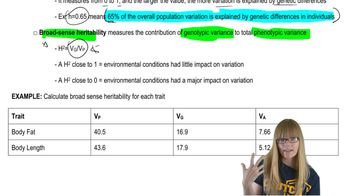
Define (e) Heritability: Explain heritability as the proportion of phenotypic variation in a population that is attributable to genetic variation among individuals, often expressed as a value between 0 and 1.
Define (f) QTL (Quantitative Trait Locus): Describe QTL as a specific region of the genome that is associated with variation in a quantitative trait, identified through statistical analysis linking genetic markers to phenotypic variation.
Define (g) Continuous variation: Explain continuous variation as a type of phenotypic variation where traits show a range of small differences across a population, often influenced by multiple genes and environmental factors, producing a smooth distribution of phenotypes.

비슷한 문제에 대한 검증된 영상 답변:

이 영상 해법은 위 문제에 도움이 된다고 튜터들이 추천한 것입니다.
영상 길이:
2m
도움이 되었나요?

주요 개념

질문에 올바르게 답하기 위해 반드시 이해해야 하는 핵심 개념들은 다음과 같습니다.

Polygenic

Polygenic refers to a trait controlled by multiple genes, each contributing a small effect to the phenotype. Unlike single-gene traits, polygenic traits show continuous variation, such as height or skin color, because the combined influence of many genes produces a range of outcomes.
추천 영상:
가이드 코스
07:56
Interacting Genes Overview

Additive Alleles

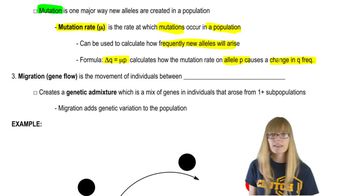
Additive alleles are gene variants whose effects sum up to influence a trait. Each allele contributes a certain amount to the phenotype, and the total effect is the sum of all alleles involved, explaining gradual differences in traits like weight or intelligence.
추천 영상:
가이드 코스
03:03
New Alleles and Migration

Heritability

Heritability measures the proportion of phenotypic variation in a population that is due to genetic differences among individuals. It ranges from 0 to 1 and helps determine how much genetics versus environment influences a trait.
추천 영상:
가이드 코스
07:04
Calculating Heritability
관련 실천
교과서 질문

Write a short essay that discusses the difference between the more traditional Mendelian and neo-Mendelian modes of inheritance (qualitative inheritance) and quantitative inheritance.

448
views
교과서 질문

How do we know that monozygotic twins are not identical genotypically as adults?

493
views
교과서 질문

How do we assess environmental factors to determine if they impact the phenotype of a quantitatively inherited trait?

453
views
교과서 질문

A dark-red strain and a white strain of wheat are crossed and produce an intermediate, medium-red F₁. When the F₁ plants are interbred, an F₂ generation is produced in a ratio of 1 dark-red: 4 medium-dark-red: 6 medium-red: 4 light-red: 1 white. Further crosses reveal that the dark-red and white F₂ plants are true breeding

Assign symbols to these alleles, and list possible genotypes that give rise to the medium-red and light-red phenotypes.

503
views
교과서 질문

A dark-red strain and a white strain of wheat are crossed and produce an intermediate, medium-red F₁. When the F₁ plants are interbred, an F₂ generation is produced in a ratio of 1 dark-red: 4 medium-dark-red: 6 medium-red: 4 light-red: 1 white. Further crosses reveal that the dark-red and white F₂ plants are true breeding

Based on the ratios in the F₂ population, how many genes are involved in the production of color?

464
views
교과서 질문

A dark-red strain and a white strain of wheat are crossed and produce an intermediate, medium-red F₁. When the F₁ plants are interbred, an F₂ generation is produced in a ratio of 1 dark-red: 4 medium-dark-red: 6 medium-red: 4 light-red: 1 white. Further crosses reveal that the dark-red and white F₂ plants are true breeding

How many additive alleles are needed to produce each possible phenotype?

438
views