Ch. 4 - Modification of Mendelian Ratios
Klug - Essentials of Genetics 10th Edition
Klug10th EditionEssentials of GeneticsISBN: 9780135588789당신이 사용하는 게 아니라요?교과서 변경
4장, 문제 15

Another recessive mutation in Drosophila, ebony (e), is on an autosome (chromosome 3) and causes darkening of the body compared with wild-type flies. What phenotypic F₁ and F₂ male and female ratios will result if a scalloped-winged female with normal body color is crossed with a normal-winged ebony male?
Work out this problem by both the Punnett square method and the forked-line method.

검증된 단계별 안내
1
Step 1: Define the alleles and their dominance relationships. Let’s denote the wing shape alleles as S (scalloped, recessive) and S+ (normal, dominant), and the body color alleles as E+ (normal body color, dominant) and e (ebony, recessive). Since ebony is autosomal and wing shape is X-linked, note that wing shape alleles are on the X chromosome, while ebony alleles are on chromosome 3 (autosome).
Step 2: Determine the genotypes of the parents. The female has scalloped wings (recessive) and normal body color, so her genotype for wing shape is X\^sX\^s (since wing shape is X-linked) and for body color is E+E+ or E+e (since she is normal-bodied, but we assume homozygous dominant unless otherwise stated). The male has normal wings (X\^+Y) and ebony body color (ee).
Step 3: Set up the Punnett square for the X-linked wing shape gene. Cross the female X\^sX\^s with the male X\^+Y to find the F₁ genotypes and phenotypes for wing shape in males and females. Remember males inherit their X chromosome from their mother and Y from their father.
Step 4: Set up the Punnett square for the autosomal ebony gene. Cross the female E+E+ (or E+e) with the male ee to find the F₁ genotypes and phenotypes for body color. Since ebony is recessive, only ee individuals will show the ebony phenotype.
Step 5: Combine the results from both Punnett squares to determine the F₁ phenotypic ratios for males and females. Then, use the F₁ genotypes to set up the F₂ crosses for both traits using the forked-line method: calculate the expected phenotypic ratios for wing shape and body color separately, then multiply these ratios to get the combined phenotypic ratios in the F₂ generation.

비슷한 문제에 대한 검증된 영상 답변:

이 영상 해법은 위 문제에 도움이 된다고 튜터들이 추천한 것입니다.
영상 길이:
2m
도움이 되었나요?

주요 개념

질문에 올바르게 답하기 위해 반드시 이해해야 하는 핵심 개념들은 다음과 같습니다.

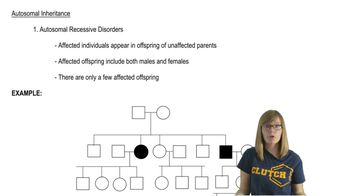
Autosomal Recessive Inheritance

Autosomal recessive traits require two copies of the mutant allele for the phenotype to be expressed. Since ebony (e) is recessive and on chromosome 3 (an autosome), both males and females can be affected equally. Heterozygous individuals show the wild-type phenotype but can pass the recessive allele to offspring.
추천 영상:
가이드 코스
09:08
Autosomal Pedigrees

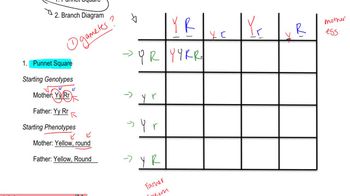
Dihybrid Cross and Punnett Square Method

A dihybrid cross involves two genes, each with two alleles, to predict offspring genotypes and phenotypes. The Punnett square visually maps all possible allele combinations from parental gametes, allowing calculation of expected phenotypic ratios in F₁ and F₂ generations.
추천 영상:

Forked-Line (Branch) Method for Probability

The forked-line method breaks down multi-gene crosses into independent single-gene crosses, calculating probabilities stepwise. It simplifies complex crosses by multiplying the probabilities of each gene's inheritance pattern to find overall phenotypic ratios.
추천 영상:
가이드 코스
07:40
Methods for Analyzing DNA and RNA