Ch. 4 - Modification of Mendelian Ratios
Klug - Essentials of Genetics 10th Edition
Klug10th EditionEssentials of GeneticsISBN: 9780135588789당신이 사용하는 게 아니라요?교과서 변경
4장, 문제 28

In Dexter and Kerry cattle, animals may be polled (hornless) or horned. The Dexter animals have short legs, whereas the Kerry animals have long legs. When many offspring were obtained from matings between polled Kerrys and horned Dexters, half were found to be polled Dexters and half polled Kerrys. When these two types of F₁ cattle were mated to one another, the following F₂ data were obtained:
3/8 polled Dexters
3/8 polled Kerrys
1/8 horned Dexters
1/8 horned Kerrys
A geneticist was puzzled by these data and interviewed farmers who had bred these cattle for decades. She learned that Kerrys were true breeding. Dexters, on the other hand, were not true breeding and never produced as many offspring as Kerrys. Provide a genetic explanation for these observations.

검증된 단계별 안내
1
Step 1: Define the traits and their possible alleles. Polled (hornless) versus horned is one trait, and leg length (short legs in Dexter, long legs in Kerry) is another. Assign symbols to these alleles, for example, let P = polled (dominant), p = horned (recessive), and for leg length, let D = short legs (Dexter), d = long legs (Kerry).
Step 2: Analyze the parental genotypes based on the information. Since Kerrys are true breeding and polled, their genotype for polled is likely homozygous dominant (PP) and for leg length homozygous recessive (dd) because they have long legs. Dexters are horned and have short legs but are not true breeding, so their genotype might be heterozygous for polled (Pp) and homozygous dominant for short legs (DD).
Step 3: Predict the F₁ generation genotypes from the cross between polled Kerrys (PP dd) and horned Dexters (Pp DD). Determine the expected genotypes and phenotypes of the offspring, considering the dominance relationships and heterozygosity.
Step 4: Examine the F₂ generation data and compare the observed phenotypic ratios (3/8 polled Dexters, 3/8 polled Kerrys, 1/8 horned Dexters, 1/8 horned Kerrys) to expected Mendelian ratios. Use a Punnett square or probability calculations to understand how these ratios arise from the F₁ cross.
Step 5: Incorporate the information about fertility differences and true breeding status. The fact that Dexters are not true breeding and produce fewer offspring suggests a genetic explanation such as a lethal allele or reduced viability associated with certain genotypes, which affects the observed ratios in the F₂ generation.

비슷한 문제에 대한 검증된 영상 답변:

이 영상 해법은 위 문제에 도움이 된다고 튜터들이 추천한 것입니다.
영상 길이:
3m
도움이 되었나요?

주요 개념

질문에 올바르게 답하기 위해 반드시 이해해야 하는 핵심 개념들은 다음과 같습니다.

Epistasis and Gene Interaction

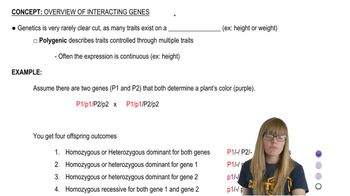
Epistasis occurs when the effect of one gene masks or modifies the effect of another gene. In this cattle example, the polled/horned trait and leg length (Dexter vs. Kerry) likely involve interacting genes, where one gene's expression depends on the genotype at another locus, explaining the unexpected phenotypic ratios.
추천 영상:
가이드 코스
07:56
Interacting Genes Overview

True Breeding and Homozygosity

True breeding organisms are homozygous for the traits they express, consistently passing them to offspring. Kerrys being true breeding suggests they are homozygous for leg length and horn status, while Dexters are heterozygous or genetically variable, leading to different offspring ratios and fertility differences.
추천 영상:

Mendelian Inheritance and Segregation Ratios

Mendelian inheritance predicts specific phenotypic ratios in offspring based on dominant and recessive alleles. The observed 3/8 and 1/8 ratios in F2 suggest a dihybrid cross with linked or interacting genes, deviating from classic 9:3:3:1 ratios, indicating complex inheritance patterns in these cattle.
추천 영상:
가이드 코스
05:13
Organelle Inheritance