Ch. 5 - Sex Determination and Sex Chromosomes
Klug - Essentials of Genetics 10th Edition
Klug10th EditionEssentials of GeneticsISBN: 9780135588789당신이 사용하는 게 아니라요?교과서 변경
5장, 문제 11

Given your answers to Problem 10, is it possible to distinguish between the Protenor and Lygaeus mode of sex determination based on the outcome of these crosses?

검증된 단계별 안내
1
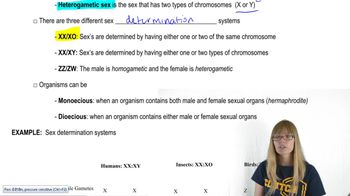
Review the definitions of the Protenor and Lygaeus modes of sex determination. In the Protenor system, sex is determined by the presence of one or two X chromosomes (XX for female, X0 for male), whereas in the Lygaeus system, sex is determined by the presence of XY (male) or XX (female) chromosomes.
Recall the expected genotypes and phenotypes of offspring from crosses involving males and females under each system. For example, in the Protenor system, males have only one X chromosome and no Y, while in the Lygaeus system, males have both X and Y chromosomes.
Analyze the outcomes of the crosses from Problem 10, focusing on the sex ratios and the presence or absence of Y chromosomes in the progeny. Determine if the progeny phenotypes or genotypes differ in a way that can be attributed to either system.
Consider whether the phenotypic ratios or genetic markers observed in the offspring can uniquely identify the mode of sex determination. If both systems produce similar offspring ratios or phenotypes, it may not be possible to distinguish between them based solely on these crosses.
Summarize your conclusion by comparing the theoretical expectations of each system with the observed data from the crosses, explaining whether the data supports distinguishing between Protenor and Lygaeus modes or not.

주요 개념

질문에 올바르게 답하기 위해 반드시 이해해야 하는 핵심 개념들은 다음과 같습니다.

Modes of Sex Determination

Sex determination systems define how sex chromosomes determine an organism's sex. The Protenor mode (XX/XO) involves females with two X chromosomes and males with one X and no Y, while the Lygaeus mode (XX/XY) has females with XX and males with XY chromosomes. Understanding these differences is key to interpreting genetic crosses.
추천 영상:
가이드 코스
04:24
Sex Determination

Genetic Cross Outcomes and Sex Ratios

Analyzing offspring sex ratios and genotypes from crosses helps infer the underlying sex determination system. In Protenor, males produce two types of gametes (X or no sex chromosome), while in Lygaeus, males produce X or Y gametes. Differences in progeny ratios can indicate which system is present.
추천 영상:
가이드 코스
10:35
Human Sex Chromosomes

Chromosomal Behavior During Meiosis

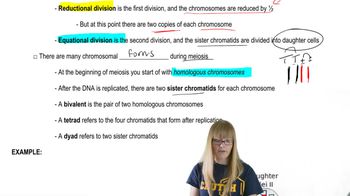
The segregation of sex chromosomes during meiosis affects gamete composition. In Protenor, males have an unpaired X chromosome that segregates randomly, producing gametes with or without X. In Lygaeus, X and Y chromosomes segregate into different gametes. This behavior influences the genetic makeup of offspring.
추천 영상:
가이드 코스
05:30
Meiosis Overview
관련 실천
교과서 질문

Assume that on rare occasions the attached X chromosomes in female gametes become unattached. Based on the parental phenotypes in Problem 12, what outcomes in the F₁ generation would indicate that this has occurred during female meiosis?

457
views
교과서 질문

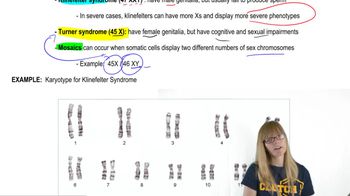
Describe how nondisjunction in human female gametes can give rise to Klinefelter and Turner syndrome offspring following fertilization by a normal male gamete.

646
views
교과서 질문

An insect species is discovered in which the heterogametic sex is unknown. An X-linked recessive mutation for reduced wing (rw) is discovered. Contrast the F1 and F2 generations from a cross between a female with reduced wings and a male with normal-sized wings when the female is the heterogametic sex.

637
views
교과서 질문

When cows have twin calves of unlike sex (fraternal twins), the female twin is usually sterile and has masculinized reproductive organs. This calf is referred to as a freemartin. In cows, twins may share a common placenta and thus fetal circulation. Predict why a freemartin develops.

1133
views
교과서 질문

An attached-X female fly, XXY, expresses the recessive X-linked white-eye mutation. It is crossed to a male fly that expresses the X-linked recessive miniature-wing mutation. Determine the outcome of this cross in terms of sex, eye color, and wing size of the offspring.

816
views
교과서 질문

An insect species is discovered in which the heterogametic sex is unknown. An X-linked recessive mutation for reduced wing (rw) is discovered. Contrast the F1 and F2 generations from a cross between a female with reduced wings and a male with normal-sized wings when the male is the heterogametic sex.

467
views