Ch. 6 - Chromosome Mutations: Variation in Number and Arrangement
Klug - Essentials of Genetics 10th Edition
Klug10th EditionEssentials of GeneticsISBN: 9780135588789당신이 사용하는 게 아니라요?교과서 변경
6장, 문제 25

A 3-year-old child exhibited some early indication of Turner syndrome, which results from a 45,X chromosome composition. Karyotypic analysis demonstrated two cell types: 46,XX (normal) and 45,X. Propose a mechanism for the origin of this mosaicism.

검증된 단계별 안내
1
Understand that Turner syndrome typically results from monosomy X (45,X), where one X chromosome is missing in all cells, but mosaicism means there are two or more different cell lines in the same individual.
Recognize that the presence of both 46,XX and 45,X cell lines suggests that the individual started from a single fertilized egg but developed two genetically distinct populations of cells.
Consider that the mosaicism could arise from a post-zygotic error, such as nondisjunction or anaphase lag, occurring during an early mitotic division after fertilization of a normal 46,XX zygote.
Specifically, anaphase lag could cause one X chromosome to be lost in some cells during mitosis, resulting in a 45,X cell line alongside the original 46,XX cells.
Summarize that the mechanism involves a mitotic error after fertilization leading to two cell populations: one normal 46,XX and one monosomic 45,X, explaining the mosaic karyotype observed.

비슷한 문제에 대한 검증된 영상 답변:

이 영상 해법은 위 문제에 도움이 된다고 튜터들이 추천한 것입니다.
영상 길이:
2m

주요 개념

질문에 올바르게 답하기 위해 반드시 이해해야 하는 핵심 개념들은 다음과 같습니다.

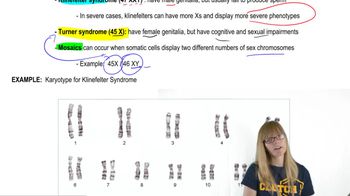
Turner Syndrome and Chromosomal Composition

Turner syndrome is a genetic condition characterized by the presence of a single X chromosome (45,X) instead of the typical two sex chromosomes. It leads to various developmental and physical features, and understanding its chromosomal basis is essential to interpret karyotype results and clinical manifestations.
추천 영상:
가이드 코스
10:35
Human Sex Chromosomes

Mosaicism in Genetics

Mosaicism occurs when an individual has two or more genetically distinct cell lines derived from a single fertilized egg. In this case, some cells have 46,XX chromosomes while others have 45,X, indicating post-zygotic chromosomal loss or nondisjunction, which results in a mixture of normal and abnormal cells.
추천 영상:
가이드 코스
08:30
Genetics of Development

Mechanisms of Chromosomal Nondisjunction and Anaphase Lag

Chromosomal mosaicism can arise from errors during cell division, such as nondisjunction, where chromosomes fail to separate properly, or anaphase lag, where a chromosome is lost during mitosis. These mechanisms explain how some cells lose an X chromosome after fertilization, producing the observed mosaic karyotype.
추천 영상:
가이드 코스
04:38
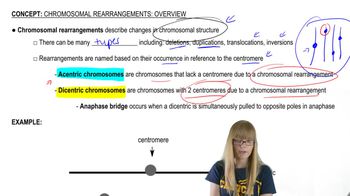
Rearrangement Overview
관련 실천
교과서 질문

A boy with Klinefelter syndrome (47,XXY) is born to a mother who is phenotypically normal and a father who has the X-linked skin condition called anhidrotic ectodermal dysplasia. The mother's skin is completely normal with no signs of the skin abnormality. In contrast, her son has patches of normal skin and patches of abnormal skin.

Using the appropriate genetic terminology, describe the meiotic mistake that occurred. Be sure to indicate in which division the mistake occurred.

1527
views
교과서 질문

A boy with Klinefelter syndrome (47,XXY) is born to a mother who is phenotypically normal and a father who has the X-linked skin condition called anhidrotic ectodermal dysplasia. The mother's skin is completely normal with no signs of the skin abnormality. In contrast, her son has patches of normal skin and patches of abnormal skin.

Using the appropriate genetic terminology, explain the son's skin phenotype.

2491
views
교과서 질문

A normal female is discovered with 45 chromosomes, one of which exhibits a Robertsonian translocation containing most of chromosomes 15 and 21. Discuss the possible outcomes in her offspring when her husband contains a normal karyotype.

896
views
교과서 질문

In a cross in Drosophila, a female heterozygous for the autosomally linked genes a, b, c, d, and e (abcde/ +++++) was testcrossed with a male homozygous for all recessive alleles. Even though the distance between each of the loci was at least 3 map units, only four phenotypes were recovered, yielding the following data:

Why are many expected crossover phenotypes missing? Can any of these loci be mapped from the data given here? If so, determine map distances.

878
views