Ch. 6 - Chromosome Mutations: Variation in Number and Arrangement
Klug - Essentials of Genetics 10th Edition
Klug10th EditionEssentials of GeneticsISBN: 9780135588789당신이 사용하는 게 아니라요?교과서 변경
6장, 문제 19a

A couple planning their family are aware that through the past three generations on the husband's side a substantial number of stillbirths have occurred and several malformed babies were born who died early in childhood. The wife has studied genetics and urges her husband to visit a genetic counseling clinic, where a complete karyotype-banding analysis is performed. Although the tests show that he has a normal complement of 46 chromosomes, banding analysis reveals that one member of the chromosome 1 pair (in group A) contains an inversion covering 70 percent of its length. The homolog of chromosome 1 and all other chromosomes show the normal banding sequence.
How would you explain the high incidence of past stillbirths?

검증된 단계별 안내
1
Understand that a chromosomal inversion occurs when a segment of a chromosome breaks off, flips around, and reattaches, altering the gene order without changing the total amount of genetic material.
Recognize that the husband carries a large inversion on one chromosome 1 homolog, covering 70% of its length, while the other homolog and all other chromosomes are normal.
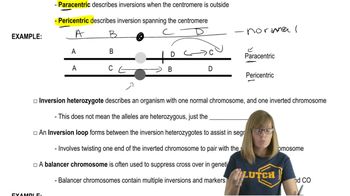
Recall that during meiosis, homologous chromosomes pair and undergo crossing over; in the presence of an inversion, this pairing forms an inversion loop to align homologous regions properly.
Note that crossing over within the inversion loop can produce recombinant chromosomes with duplications and deletions, leading to unbalanced gametes.
Conclude that fertilization involving these unbalanced gametes can result in embryos with genetic imbalances, causing stillbirths or severe malformations, explaining the high incidence of these outcomes in the husband's family history.

비슷한 문제에 대한 검증된 영상 답변:

이 영상 해법은 위 문제에 도움이 된다고 튜터들이 추천한 것입니다.
영상 길이:
41s

주요 개념

질문에 올바르게 답하기 위해 반드시 이해해야 하는 핵심 개념들은 다음과 같습니다.

Chromosomal Inversions

A chromosomal inversion occurs when a segment of a chromosome breaks off, flips, and reinserts in the reverse orientation. Although the total genetic material remains the same, inversions can disrupt gene function or interfere with chromosome pairing during meiosis, potentially leading to abnormal gametes.
추천 영상:

Meiotic Pairing and Recombination in Inversion Heterozygotes

In individuals heterozygous for an inversion, homologous chromosomes form inversion loops during meiosis to align properly. Crossing over within the inverted segment can produce unbalanced gametes with duplications or deletions, increasing the risk of miscarriages, stillbirths, or congenital abnormalities in offspring.
추천 영상:

Genetic Counseling and Karyotype Analysis

Genetic counseling uses karyotype analysis to detect chromosomal abnormalities like inversions. Even with a normal chromosome count, banding patterns reveal structural changes that can explain recurrent reproductive issues. Counseling helps families understand risks and reproductive options.
추천 영상:
가이드 코스
02:48
Chi Square Analysis
관련 실천
교과서 질문

Mendelian ratios are modified in crosses involving autotetraploids. Assume that one plant expresses the dominant trait green seeds and is homozygous (WWWW). This plant is crossed to one with white seeds that is also homozygous (wwww). If only one dominant allele is sufficient to produce green seeds, predict the F₁ and F₂ results of such a cross. Assume that synapsis between chromosome pairs is random during meiosis.

710
views
교과서 질문

A couple planning their family are aware that through the past three generations on the husband's side a substantial number of stillbirths have occurred and several malformed babies were born who died early in childhood. The wife has studied genetics and urges her husband to visit a genetic counseling clinic, where a complete karyotype-banding analysis is performed. Although the tests show that he has a normal complement of 46 chromosomes, banding analysis reveals that one member of the chromosome 1 pair (in group A) contains an inversion covering 70 percent of its length. The homolog of chromosome 1 and all other chromosomes show the normal banding sequence.

Would you advise the woman that she will have to bring each pregnancy to term to determine whether the fetus is normal? If not, what else can you suggest?

449
views
교과서 질문

A couple planning their family are aware that through the past three generations on the husband's side a substantial number of stillbirths have occurred and several malformed babies were born who died early in childhood. The wife has studied genetics and urges her husband to visit a genetic counseling clinic, where a complete karyotype-banding analysis is performed. Although the tests show that he has a normal complement of 46 chromosomes, banding analysis reveals that one member of the chromosome 1 pair (in group A) contains an inversion covering 70 percent of its length. The homolog of chromosome 1 and all other chromosomes show the normal banding sequence.

What can you predict about the probability of abnormality/normality of their future children?

430
views
교과서 질문

A woman who sought genetic counseling is found to be heterozygous for a chromosomal rearrangement between the second and third chromosomes. Her chromosomes, compared to those in a normal karyotype, are diagrammed to the right.

What kind of chromosomal aberration is shown?

632
views
교과서 질문

Having correctly established the F₂ ratio in Problem 18, predict the F₂ ratio of a 'dihybrid' cross involving two independently assorting characteristics (e.g., P₁ = WWWWAAAA x wwwwaaaa).

643
views