Explain the observations that led Zinder and Lederberg to conclude that the prototrophs recovered in their transduction experiments were not the result of F⁺ mediated conjugation.
Ch. 8 - Genetic Analysis and Mapping in Bacteria and Bacteriophages
8장, 문제 16
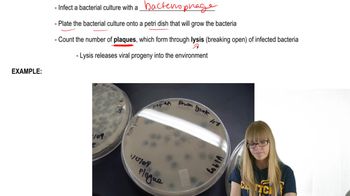
Define plaque, lysogeny, and prophage.
검증된 단계별 안내1
Define 'plaque' as a clear zone on a bacterial lawn where bacteriophages have infected and lysed the bacterial cells, indicating areas of cell destruction caused by viral infection.
Explain 'lysogeny' as a viral life cycle in which the bacteriophage integrates its genome into the host bacterial chromosome, existing in a dormant state without causing immediate lysis of the host cell.
Describe 'prophage' as the viral DNA that has been integrated into the bacterial genome during lysogeny, which can replicate along with the host DNA and remain latent until induced to enter the lytic cycle.
Clarify that plaques are visible evidence of the lytic cycle, whereas lysogeny and prophage represent a dormant phase of the virus within the host.
Summarize the relationship: plaques result from lytic infection, lysogeny is the dormant integration phase, and prophage is the integrated viral DNA within the host genome.

비슷한 문제에 대한 검증된 영상 답변:
이 영상 해법은 위 문제에 도움이 된다고 튜터들이 추천한 것입니다.
영상 길이:
1m도움이 되었나요?
주요 개념
질문에 올바르게 답하기 위해 반드시 이해해야 하는 핵심 개념들은 다음과 같습니다.
Plaque
A plaque is a clear zone formed on a bacterial lawn where bacteriophages have infected and lysed bacterial cells. It represents areas of bacterial cell death caused by viral replication and release, useful for quantifying phage particles.
추천 영상:
가이드 코스
Plaques and Experiments
Lysogeny
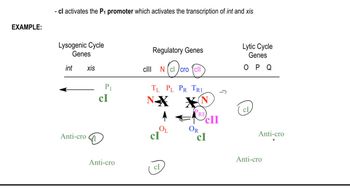
Lysogeny is a viral life cycle in which a bacteriophage integrates its genome into the host bacterial chromosome, remaining dormant as a prophage. The host cell continues to live and reproduce, passing the viral DNA to daughter cells.
추천 영상:
가이드 코스
Decision Between Lytic and Lysogenic Cycles
Prophage
A prophage is the viral DNA integrated into the bacterial genome during lysogeny. It remains inactive but can later be induced to enter the lytic cycle, producing new phages and lysing the host cell.
추천 영상:
가이드 코스
Plaques and Experiments
관련 실천
교과서 질문
1014
views
교과서 질문
A plaque assay is performed beginning with 1 mL of a solution containing bacteriophages. This solution is serially diluted three times by combining 0.1 mL of each sequential dilution with 9.9 mL of liquid medium. Then 0.1 mL of the final dilution is plated in the plaque assay and yields 17 plaques. What is the initial density of bacteriophages in the original 1 mL?
890
views
교과서 질문
If a single bacteriophage infects one E. coli cell present on a lawn of bacteria and, upon lysis, yields 200 viable viruses, how many phages will exist in a single plaque if three more lytic cycles occur?
1132
views