Ch. 8 - Genetic Analysis and Mapping in Bacteria and Bacteriophages
Klug - Essentials of Genetics 10th Edition
Klug10th EditionEssentials of GeneticsISBN: 9780135588789당신이 사용하는 게 아니라요?교과서 변경
8장, 문제 3

Distinguish among the three modes of recombination in bacteria.

검증된 단계별 안내
1
Understand that recombination in bacteria refers to the process by which genetic material is exchanged or rearranged, leading to genetic variation.
Identify the three main modes of bacterial recombination: transformation, transduction, and conjugation.
Define transformation as the uptake of free DNA fragments from the environment by a bacterial cell, which can then integrate into its genome.
Explain transduction as the transfer of bacterial DNA from one cell to another via a bacteriophage (a virus that infects bacteria).
Describe conjugation as the direct transfer of DNA between two bacterial cells through physical contact, often mediated by a pilus.

주요 개념

질문에 올바르게 답하기 위해 반드시 이해해야 하는 핵심 개념들은 다음과 같습니다.

Transformation

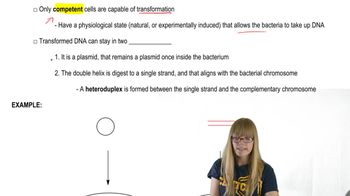
Transformation is the process by which bacteria take up free DNA fragments from their environment and incorporate them into their own genome. This mode allows genetic variation without cell-to-cell contact and was first demonstrated in Streptococcus pneumoniae.
추천 영상:

Conjugation

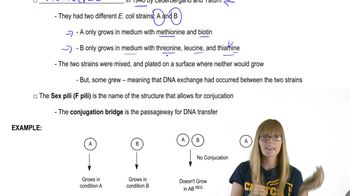
Conjugation involves direct transfer of DNA between two bacterial cells through a physical connection called a pilus. It typically transfers plasmids or chromosomal segments, enabling rapid spread of traits like antibiotic resistance.
추천 영상:
가이드 코스
04:06
Conjugation Overview

Transduction

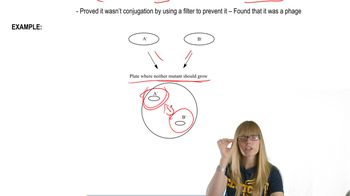
Transduction is the transfer of bacterial DNA from one cell to another via bacteriophages (viruses that infect bacteria). During infection, phages accidentally package host DNA and introduce it into new bacterial cells, facilitating genetic exchange.
추천 영상: