Ch. 8 - Genetic Analysis and Mapping in Bacteria and Bacteriophages
Klug - Essentials of Genetics 10th Edition
Klug10th EditionEssentials of GeneticsISBN: 9780135588789당신이 사용하는 게 아니라요?교과서 변경
8장, 문제 1c

In this chapter, we have focused on genetic systems present in bacteria and the viruses that use bacteria as hosts (bacteriophages). In particular, we discussed mechanisms by which bacteria and their phages undergo genetic recombination, the basis of chromosome mapping. Based on your knowledge of these topics, answer several fundamental questions:


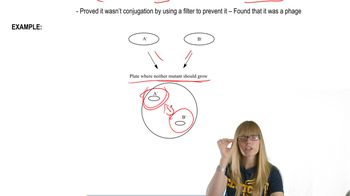
How do we know that during transduction bacterial cell-to-cell contact is not essential?

검증된 단계별 안내
1
Recall that transduction is a process where bacteriophages transfer genetic material from one bacterial cell to another, without requiring direct contact between the bacterial cells themselves.
Understand that in transduction, a bacteriophage infects a donor bacterial cell and accidentally packages fragments of the host bacterial DNA into its viral particles during assembly.
Recognize that these phage particles then infect recipient bacterial cells, injecting the donor DNA into them, which can recombine with the recipient's genome.
Note that because the transfer of DNA is mediated by the phage particles moving through the environment, physical contact between donor and recipient bacteria is not necessary.
Therefore, experimental evidence showing genetic exchange via phage particles in mixed bacterial cultures without cell-to-cell contact supports the conclusion that transduction does not require bacterial cell contact.

주요 개념

질문에 올바르게 답하기 위해 반드시 이해해야 하는 핵심 개념들은 다음과 같습니다.

Transduction in Bacteria

Transduction is a process where bacteriophages transfer genetic material between bacterial cells without direct contact. During this process, phages accidentally package bacterial DNA and inject it into another bacterium, facilitating genetic recombination independently of cell-to-cell contact.
추천 영상:

Role of Bacteriophages in Genetic Transfer

Bacteriophages act as vectors that mediate gene transfer by infecting bacteria and transferring DNA. Since phages can move freely in the environment, they enable genetic exchange between bacteria that are not physically touching, demonstrating that direct contact is unnecessary.
추천 영상:
가이드 코스
06:04
Mapping Bacteriophages

Experimental Evidence for Transduction Mechanism

Experiments showing gene transfer in liquid cultures where bacteria are separated or inactivated prove that physical contact is not required. The ability of phages to mediate gene transfer in such conditions confirms that transduction occurs via phage particles rather than direct bacterial contact.
추천 영상: