Ch. 9 - DNA Structure and Analysis
Klug - Essentials of Genetics 10th Edition
Klug10th EditionEssentials of GeneticsISBN: 9780135588789당신이 사용하는 게 아니라요?교과서 변경
9장, 문제 2

Most center around DNA and RNA and their role of serving as the genetic material. Write a short essay that contrasts these molecules, including a comparison of advantages conferred by their structure that each of them has over the other in serving in this role.

검증된 단계별 안내
1
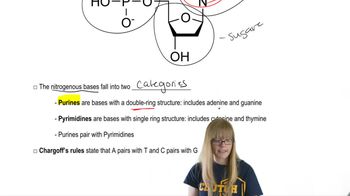
Begin by defining DNA and RNA, highlighting that both are nucleic acids composed of nucleotides, but differ in sugar components and nitrogenous bases. DNA contains deoxyribose sugar and uses thymine, while RNA contains ribose sugar and uses uracil instead of thymine.
Explain the structural differences: DNA is typically double-stranded forming a stable double helix, whereas RNA is usually single-stranded and can fold into various shapes. Discuss how the double-stranded nature of DNA provides stability and protection for genetic information.
Discuss the functional roles: DNA serves as the long-term storage of genetic information, while RNA plays multiple roles including messenger RNA (mRNA) for protein synthesis, transfer RNA (tRNA), and ribosomal RNA (rRNA).
Compare the advantages of DNA's structure, such as its chemical stability due to the lack of a hydroxyl group on the 2' carbon of deoxyribose, which makes it less prone to hydrolysis and mutation, making it ideal for long-term information storage.
Contrast this with RNA's advantages, such as its ability to fold into complex three-dimensional structures enabling catalytic activity (ribozymes) and its flexibility for diverse functions in gene expression and regulation.

비슷한 문제에 대한 검증된 영상 답변:

이 영상 해법은 위 문제에 도움이 된다고 튜터들이 추천한 것입니다.
영상 길이:
1m

주요 개념

질문에 올바르게 답하기 위해 반드시 이해해야 하는 핵심 개념들은 다음과 같습니다.

Structural Differences Between DNA and RNA

DNA is a double-stranded molecule with a deoxyribose sugar and thymine bases, while RNA is typically single-stranded with a ribose sugar and uracil replacing thymine. These structural differences influence their stability and function in the cell.
추천 영상:

Stability and Function in Genetic Information Storage

DNA's double helix and deoxyribose sugar make it chemically more stable, ideal for long-term genetic information storage. RNA's single-stranded structure and ribose sugar make it more reactive and suitable for temporary roles like protein synthesis.
추천 영상:
가이드 코스
08:26
Functional Genomics

Functional Roles and Advantages in Genetic Processes

DNA serves as the permanent genetic blueprint, while RNA acts as a versatile intermediary in gene expression, including mRNA, tRNA, and rRNA. RNA's ability to fold into complex structures allows it to perform catalytic and regulatory functions that DNA cannot.
추천 영상:
가이드 코스
08:26
Functional Genomics