Ch. 9 - DNA Structure and Analysis
Klug - Essentials of Genetics 10th Edition
Klug10th EditionEssentials of GeneticsISBN: 9780135588789당신이 사용하는 게 아니라요?교과서 변경
9장, 문제 30b

Newsdate: March 1, 2030. A unique creature has been discovered during exploration of outer space. Recently, its genetic material has been isolated and analyzed. This material is similar in some ways to DNA in its chemical makeup. It contains in abundance the 4-carbon sugar erythrose and a molar equivalent of phosphate groups. In addition, it contains six nitrogenous bases: adenine (A), guanine (G), thymine (T), cytosine (C), hypoxanthine (H), and xanthine (X). These bases exist in the following relative proportions:
A =T = H and C = G = X
X-ray diffraction studies have established a regularity in the molecule and a constant diameter of about 30 Å. Together, these data have suggested a model for the structure of this molecule.
What base-pairing properties must exist for H and for X in the model?

검증된 단계별 안내
1
Step 1: Understand the given base proportions and their equivalences. The problem states that A = T = H and C = G = X in relative amounts, suggesting that these bases form pairs with equal molar ratios, similar to Chargaff's rules in DNA.
Step 2: Recall the base-pairing rules in DNA: adenine (A) pairs with thymine (T) via two hydrogen bonds, and cytosine (C) pairs with guanine (G) via three hydrogen bonds. These pairs maintain a constant diameter of the double helix.
Step 3: Since the molecule has a constant diameter (~30 Å) and the sugar-phosphate backbone is similar to DNA, the new bases hypoxanthine (H) and xanthine (X) must pair in a way that preserves this diameter and the regularity of the structure.
Step 4: Given the equivalences A = T = H and C = G = X, hypothesize that hypoxanthine (H) pairs with adenine (A) or thymine (T) analogously, and xanthine (X) pairs with cytosine (C) or guanine (G) analogously, maintaining complementary pairing and hydrogen bonding patterns.
Step 5: Conclude that the base-pairing properties of H and X must allow them to form stable hydrogen bonds with their complementary bases, preserving the molecular geometry and constant diameter, similar to how A-T and C-G pairs function in DNA.

비슷한 문제에 대한 검증된 영상 답변:

이 영상 해법은 위 문제에 도움이 된다고 튜터들이 추천한 것입니다.
영상 길이:
1m
도움이 되었나요?

주요 개념

질문에 올바르게 답하기 위해 반드시 이해해야 하는 핵심 개념들은 다음과 같습니다.

Base Pairing Rules in Nucleic Acids

Base pairing involves specific hydrogen bonding between nitrogenous bases, ensuring complementary pairing and stable double-stranded structures. In DNA, adenine pairs with thymine, and guanine pairs with cytosine, maintaining consistent molecular dimensions. Understanding these rules helps predict how novel bases like hypoxanthine (H) and xanthine (X) might pair to preserve structural regularity.
추천 영상:
가이드 코스
08:44
Genetics Basics

Chemical Structure and Properties of Nitrogenous Bases

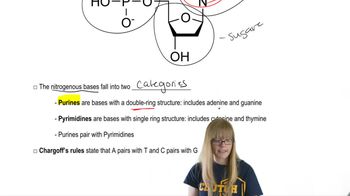
Nitrogenous bases differ in ring structure and functional groups, influencing their hydrogen bonding capabilities. Hypoxanthine and xanthine are modified purines with keto and amino groups that affect their pairing potential. Analyzing their chemical groups helps determine possible complementary partners and the nature of hydrogen bonds they can form.
추천 영상:

Molecular Geometry and Structural Constraints of Nucleic Acids

The uniform diameter (~30 Å) and regularity observed via X-ray diffraction imply strict spatial constraints on base pairing. Complementary bases must fit within this geometry to maintain the molecule’s stability. This concept guides the prediction of how new bases pair to preserve consistent width and helical structure.
추천 영상:
가이드 코스
03:49
Ribosome Structure
관련 실천
교과서 질문

One of the most common spontaneous lesions that occurs in DNA under physiological conditions is the hydrolysis of the amino group of cytosine, converting the cytosine to uracil. What would be the effect on DNA structure of a uracil group replacing cytosine?

674
views
교과서 질문

Newsdate: March 1, 2030. A unique creature has been discovered during exploration of outer space. Recently, its genetic material has been isolated and analyzed. This material is similar in some ways to DNA in its chemical makeup. It contains in abundance the 4-carbon sugar erythrose and a molar equivalent of phosphate groups. In addition, it contains six nitrogenous bases: adenine (A), guanine (G), thymine (T), cytosine (C), hypoxanthine (H), and xanthine (X). These bases exist in the following relative proportions:

A =T = H and C = G = X

X-ray diffraction studies have established a regularity in the molecule and a constant diameter of about 30 Å. Together, these data have suggested a model for the structure of this molecule.

Given the constant diameter of 30 Å, do you think that either (i) both H and X are purines or both pyrimidines, or (ii) one is a purine and one is a pyrimidine?
596
views
교과서 질문

During gel electrophoresis, DNA molecules can easily be separated according to size because all DNA molecules have the same charge-to-mass ratio and the same shape (long rod). Would you expect RNA molecules to behave in the same manner as DNA during gel electrophoresis? Why or why not?

822
views
교과서 질문

Newsdate: March 1, 2030. A unique creature has been discovered during exploration of outer space. Recently, its genetic material has been isolated and analyzed. This material is similar in some ways to DNA in its chemical makeup. It contains in abundance the 4-carbon sugar erythrose and a molar equivalent of phosphate groups. In addition, it contains six nitrogenous bases: adenine (A), guanine (G), thymine (T), cytosine (C), hypoxanthine (H), and xanthine (X). These bases exist in the following relative proportions:

A =T = H and C = G = X

X-ray diffraction studies have established a regularity in the molecule and a constant diameter of about 30 Å. Together, these data have suggested a model for the structure of this molecule.

Propose a general model of this molecule. Describe it briefly.

541
views
교과서 질문

In some organisms, cytosine is methylated at carbon 5 of the pyrimidine ring after it is incorporated into DNA. If a 5-methyl cytosine molecule is then hydrolyzed, what base will be generated?

643
views