Ch. 15 - Gene Mutation, DNA Repair, and Transposition
Klug - Concepts of Genetics 12th Edition
Klug12th EditionConcepts of GeneticsISBN: 9780135564776당신이 사용하는 게 아니라요?교과서 변경
15장, 문제 10

Contrast and compare the mutagenic effects of deaminating agents, alkylating agents, and base analogs.

검증된 단계별 안내
1
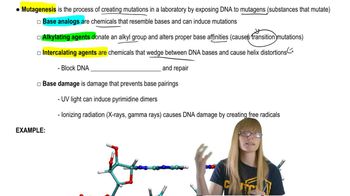
Step 1: Define each type of mutagenic agent to understand their basic nature. Deaminating agents remove amino groups from bases, alkylating agents add alkyl groups to bases, and base analogs are structurally similar to normal bases but can be incorporated into DNA during replication.
Step 2: Explain the mechanism of mutagenesis for deaminating agents. They typically convert cytosine to uracil by removing an amino group, which can lead to a C:G to T:A transition mutation during DNA replication.
Step 3: Describe how alkylating agents cause mutations. They add alkyl groups (like methyl or ethyl) to bases, which can mispair during replication, often resulting in base substitutions or even DNA strand breaks.
Step 4: Discuss the role of base analogs. Because they resemble normal bases, they can be incorporated into DNA in place of the usual bases, but they often pair incorrectly, leading to point mutations during subsequent rounds of replication.
Step 5: Compare and contrast the effects by highlighting that deaminating agents cause specific base changes through chemical modification, alkylating agents cause a broader range of mutations by altering base pairing properties, and base analogs cause mutations by mimicking bases but pairing incorrectly, emphasizing their different mutagenic pathways.

비슷한 문제에 대한 검증된 영상 답변:

이 영상 해법은 위 문제에 도움이 된다고 튜터들이 추천한 것입니다.
영상 길이:
1m

주요 개념

질문에 올바르게 답하기 위해 반드시 이해해야 하는 핵심 개념들은 다음과 같습니다.

Deaminating Agents

Deaminating agents cause mutations by removing amino groups from nucleotide bases, often converting cytosine to uracil or adenine to hypoxanthine. This alteration leads to incorrect base pairing during DNA replication, resulting in point mutations such as transitions.
추천 영상:
가이드 코스
04:29
Induced Mutations

Alkylating Agents

Alkylating agents add alkyl groups to DNA bases, which can cause mispairing or strand breaks. These modifications often result in base substitutions or cross-linking, disrupting normal DNA replication and leading to mutations or cytotoxicity.
추천 영상:
가이드 코스
04:29
Induced Mutations

Base Analogs

Base analogs are structurally similar to normal bases but differ slightly, allowing them to be incorporated into DNA during replication. Their presence can cause mispairing or increased mutation rates because they pair incorrectly or undergo tautomeric shifts.
추천 영상:
가이드 코스
03:49
Base Distortions