Describe the manner in which activators and repressors influence the rate of transcription initiation. How might chromatin structure be involved in such regulation?
Ch. 17 - Transcriptional Regulation in Eukaryotes

17장, 문제 10
Explain how the addition of acetyl groups to histones leads to a weaker association of DNA in nucleosomes.
검증된 단계별 안내1
Histones are proteins around which DNA is wrapped to form nucleosomes, the basic units of chromatin structure.
Histones have positively charged lysine residues that interact with the negatively charged phosphate groups of DNA, leading to a tight association.
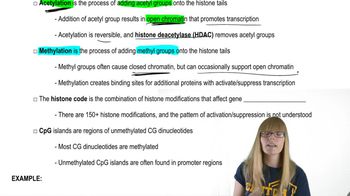
Acetylation involves the addition of acetyl groups (CH3CO) to the lysine residues on histone tails.
The addition of acetyl groups neutralizes the positive charge on lysine residues, reducing the electrostatic attraction between histones and DNA.
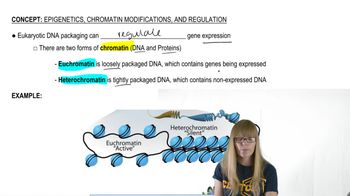
This reduction in attraction results in a looser association of DNA with histones, making the DNA more accessible for transcription and other processes.

비슷한 문제에 대한 검증된 영상 답변:
이 영상 해법은 위 문제에 도움이 된다고 튜터들이 추천한 것입니다.
영상 길이:
4m주요 개념
질문에 올바르게 답하기 위해 반드시 이해해야 하는 핵심 개념들은 다음과 같습니다.
Histone Acetylation
Histone acetylation is a post-translational modification where acetyl groups are added to the lysine residues of histone proteins. This modification neutralizes the positive charge of lysines, reducing the affinity between histones and the negatively charged DNA. As a result, the chromatin structure becomes more relaxed, facilitating access to the DNA for transcription and other processes.
추천 영상:
가이드 코스
Histone Protein Modifications
Nucleosome Structure
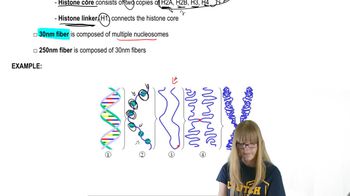
Nucleosomes are the fundamental units of chromatin, consisting of DNA wrapped around a core of histone proteins. Each nucleosome contains approximately 147 base pairs of DNA and is connected by linker DNA. The structural arrangement of nucleosomes plays a crucial role in the compaction of DNA and the regulation of gene expression, as tighter packing can inhibit access to the DNA.
추천 영상:
가이드 코스
Chromosome Structure
Chromatin Remodeling
Chromatin remodeling refers to the dynamic changes in the structure of chromatin that allow for the regulation of gene expression. This process involves the repositioning or restructuring of nucleosomes, often facilitated by ATP-dependent chromatin remodeling complexes. Acetylation of histones is one mechanism that promotes chromatin remodeling, leading to a more open and accessible chromatin state, which is essential for transcriptional activation.
추천 영상:
가이드 코스
Chromatin
관련 실천
교과서 질문
584
views
교과서 질문
Enhancers can influence the transcription of genes far away on the same chromosome. How are the effects of enhancers restricted so that they do not exert inappropriate transcriptional activation of non-target genes?
759
views
교과서 질문
Present an overview of the manner in which chromatin can be remodeled. Describe the manner in which these remodeling processes influence transcription.
534
views
교과서 질문
Distinguish between the cis-acting regulatory elements referred to as promoters and enhancers.
652
views
교과서 질문
Chromatin remodeling by the SWI/SNF complex requires hydrolysis of ATP. What purpose does this serve?
592
views
교과서 질문
Provide a brief description of two different types of histone modification and how they impact transcription.
709
views