Ch. 11 - Gene Mutation, DNA Repair, and Homologous Recombination
Sanders - Genetic Analysis: An Integrated Approach 3rd Edition
Sanders3rd EditionGenetic Analysis: An Integrated ApproachISBN: 9780135564172당신이 사용하는 게 아니라요?교과서 변경
11장, 문제 41c

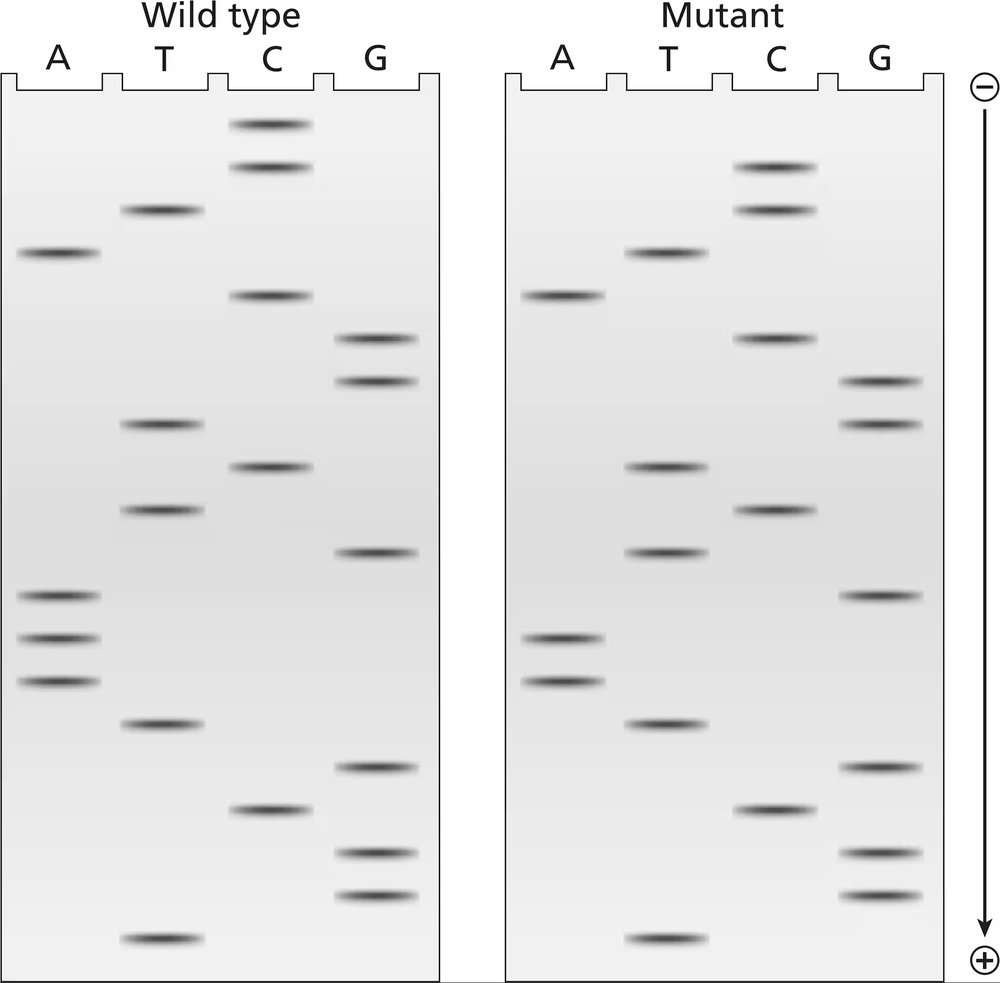
The two gels illustrated contain dideoxynucleotide DNA-sequencing information for a wild-type segment and mutant segment of DNA corresponding to the N-terminal end of a protein. The start codon and the next five codons are sequenced.
Two DNA sequencing gels show wild-type and mutant segments, highlighting start codons and codon sequences.
Write out the mRNA sequences encoded by each template strand, and underline the start codons.

검증된 단계별 안내
1
Identify the DNA template strands for both the wild-type and mutant segments from the gel data. Remember, the template strand is complementary to the mRNA sequence.
Determine the mRNA sequence by transcribing the DNA template strand. Use the base-pairing rules: Adenine (A) pairs with Uracil (U), Thymine (T) pairs with Adenine (A), Cytosine (C) pairs with Guanine (G), and Guanine (G) pairs with Cytosine (C).
Locate the start codon (AUG) in the mRNA sequence. This codon signals the beginning of translation and corresponds to the start of the protein-coding region.
Underline the start codon (AUG) in the mRNA sequence for both the wild-type and mutant segments to clearly indicate the translation initiation site.
Write out the full mRNA sequences for both the wild-type and mutant segments, ensuring the start codons are underlined for clarity.

비슷한 문제에 대한 검증된 영상 답변:

이 영상 해법은 위 문제에 도움이 된다고 튜터들이 추천한 것입니다.
영상 길이:
1m

주요 개념

질문에 올바르게 답하기 위해 반드시 이해해야 하는 핵심 개념들은 다음과 같습니다.

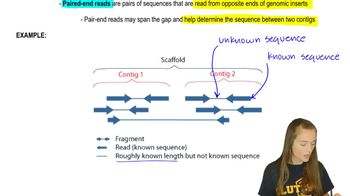
DNA Sequencing

DNA sequencing is a method used to determine the precise order of nucleotides within a DNA molecule. In the context of the question, dideoxynucleotide sequencing allows for the identification of specific sequences by terminating DNA strand elongation at dideoxynucleotides, which are incorporated during replication. This technique is crucial for analyzing genetic variations between wild-type and mutant DNA segments.
추천 영상:
가이드 코스
08:41
Sequencing Difficulties

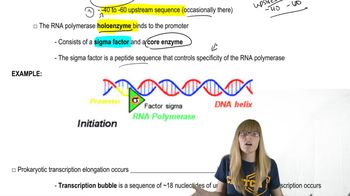
mRNA Transcription

mRNA transcription is the process by which a segment of DNA is copied into messenger RNA (mRNA) by the enzyme RNA polymerase. The mRNA sequence is complementary to the DNA template strand and carries the genetic information needed for protein synthesis. Understanding how to transcribe the DNA sequence into mRNA is essential for answering the question regarding the encoded sequences.
추천 영상:
가이드 코스
10:14
Prokaryotic Transcription

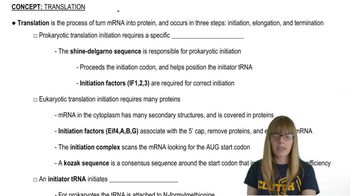
Start Codon

The start codon is a specific nucleotide triplet within mRNA that signals the beginning of translation, typically AUG, which codes for the amino acid methionine. Identifying the start codon is crucial for determining where protein synthesis begins. In the context of the question, underlining the start codon in the mRNA sequence helps highlight the point at which the ribosome will initiate translation.
추천 영상:
가이드 코스
07:58
Translation initiation
관련 실천
교과서 질문

The two gels illustrated contain dideoxynucleotide DNA-sequencing information for a wild-type segment and mutant segment of DNA corresponding to the N-terminal end of a protein. The start codon and the next five codons are sequenced.

What is the cause of the mutation?

427
views
교과서 질문

The two gels illustrated contain dideoxynucleotide DNA-sequencing information for a wild-type segment and mutant segment of DNA corresponding to the N-terminal end of a protein. The start codon and the next five codons are sequenced.

Write the DNA sequence of both alleles, including strand polarity.

554
views
교과서 질문

The two gels illustrated contain dideoxynucleotide DNA-sequencing information for a wild-type segment and mutant segment of DNA corresponding to the N-terminal end of a protein. The start codon and the next five codons are sequenced.

Identify the template and nontemplate strands of DNA.

605
views
교과서 질문

Common baker's yeast (Saccharomyces cerevisiae) is normally grown at 37°C, but it will grow actively at temperatures down to approximately 25°C. A haploid culture of wild-type yeast is mutagenized with EMS. Cells from the mutagenized culture are spread on a complete-medium plate and grown at 25°C. Six colonies (1 to 6) are selected from the original complete-medium plate and transferred to two fresh complete-medium plates. The new complete plates (shown) are grown at 25°C and 37°C. Four replica plates are made onto minimal medium or minimal plus adenine from the 25°C complete-medium plate. The new plates are grown at either 25°C or 37°C and the growth results are shown.

What can you say about colony 4?

1034
views
교과서 질문

The two gels illustrated contain dideoxynucleotide DNA-sequencing information for a wild-type segment and mutant segment of DNA corresponding to the N-terminal end of a protein. The start codon and the next five codons are sequenced.

Determine the amino acid sequences translated from these mRNAs.

584
views