Ch. 11 - Gene Mutation, DNA Repair, and Homologous Recombination
Sanders - Genetic Analysis: An Integrated Approach 3rd Edition
Sanders3rd EditionGenetic Analysis: An Integrated ApproachISBN: 9780135564172당신이 사용하는 게 아니라요?교과서 변경
11장, 문제 11c

Two different mutations are identified in a haploid strain of yeast. The first prevents the synthesis of adenine by a nonsense mutation of the ade-1 gene. In this mutation, a base-pair substitution changes a tryptophan codon (UGG) to a stop codon (UGA). The second affects one of several duplicate tRNA genes. This base-pair substitution mutation changes the anticodon sequence of a tRNAᵀʳᵖ from


   3′−ACC−5′ to 3′−ACU−5′


Assuming there are no other mutations in the genome, will this double-mutant yeast strain be able to grow on minimal medium? If growth will occur, characterize the nature of growth relative to wild type.

검증된 단계별 안내
1
Understand the first mutation: The nonsense mutation in the ade-1 gene changes a tryptophan codon (UGG) to a stop codon (UGA). This prevents the synthesis of adenine, which is essential for yeast growth on minimal medium. Without adenine, the yeast cannot grow unless the mutation is suppressed or adenine is supplemented.
Analyze the second mutation: The second mutation alters the anticodon of a tRNAᵀʳᵖ from 3′−ACC−5′ to 3′−ACU−5′. This change allows the tRNA to recognize the stop codon UGA and insert tryptophan during translation, potentially suppressing the nonsense mutation in the ade-1 gene.
Determine the effect of the second mutation: The modified tRNAᵀʳᵖ can suppress the nonsense mutation by inserting tryptophan at the UGA stop codon. This suppression may restore the production of a functional Ade-1 protein, enabling adenine synthesis.
Evaluate the growth of the double-mutant strain: If the suppression is effective, the double-mutant yeast strain will be able to synthesize adenine and grow on minimal medium. However, the growth may not be as robust as the wild type due to potential inefficiencies in suppression or other cellular effects of the modified tRNA.
Characterize the nature of growth: If growth occurs, it is likely to be slower or less efficient than the wild type because the suppression mechanism is not perfect, and the modified tRNA may interfere with normal translation processes. This would result in a phenotype that is partially rescued relative to the wild type.

비슷한 문제에 대한 검증된 영상 답변:

이 영상 해법은 위 문제에 도움이 된다고 튜터들이 추천한 것입니다.
영상 길이:
1m

주요 개념

질문에 올바르게 답하기 위해 반드시 이해해야 하는 핵심 개념들은 다음과 같습니다.

Nonsense Mutation

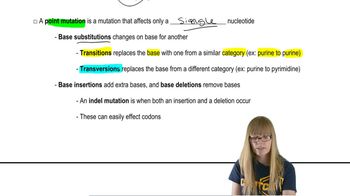
A nonsense mutation is a type of point mutation where a single nucleotide change results in a premature stop codon in the coding sequence of a gene. This leads to the truncation of the protein, often rendering it nonfunctional. In the context of the ade-1 gene in yeast, the mutation prevents the synthesis of adenine, which is essential for growth on minimal medium.
추천 영상:
가이드 코스
09:49
Point Mutations

tRNA and Anticodon

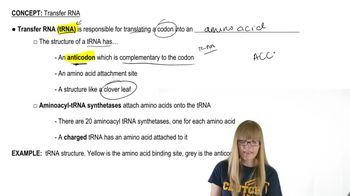
Transfer RNA (tRNA) is a type of RNA molecule that helps decode a messenger RNA (mRNA) sequence into a protein. Each tRNA has an anticodon that pairs with a corresponding codon on the mRNA. The mutation described changes the anticodon of a tRNAᵀʳᵖ, which may affect the translation of specific amino acids, potentially impacting protein synthesis and cellular function.
추천 영상:

Minimal Medium Growth

Minimal medium is a growth medium that contains only the essential nutrients required for the growth of an organism, such as carbon sources, salts, and a nitrogen source. For yeast to grow on minimal medium, it must be able to synthesize all necessary metabolites, including adenine. The presence of the nonsense mutation in the ade-1 gene suggests that the double-mutant strain may not be able to grow on minimal medium unless the tRNA mutation compensates for the loss of adenine synthesis.
추천 영상:
가이드 코스
04:06
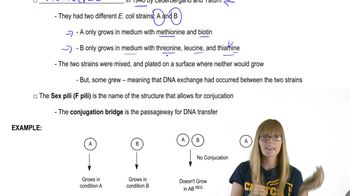
Conjugation Overview
관련 실천
교과서 질문

Two different mutations are identified in a haploid strain of yeast. The first prevents the synthesis of adenine by a nonsense mutation of the ade-1 gene. In this mutation, a base-pair substitution changes a tryptophan codon (UGG) to a stop codon (UGA). The second affects one of several duplicate tRNA genes. This base-pair substitution mutation changes the anticodon sequence of a tRNAᵀʳᵖ from


   3′−ACC−5′ to 3′−ACU−5′


Do you consider the first mutation to be a forward mutation or a reversion? Why?

470
views
교과서 질문

Answer the following questions concerning the accuracy of DNA polymerase during replication.

If a DNA replication error is detected by DNA polymerase, how is it corrected?

419
views
교과서 질문

In numerous population studies of spontaneous mutation, two observations are made consistently: (1) Most mutations are recessive, and (2) forward mutation is more frequent than reversion. What do you think are the likely explanations for these two observations?

514
views
교과서 질문

Two different mutations are identified in a haploid strain of yeast. The first prevents the synthesis of adenine by a nonsense mutation of the ade-1 gene. In this mutation, a base-pair substitution changes a tryptophan codon (UGG) to a stop codon (UGA). The second affects one of several duplicate tRNA genes. This base-pair substitution mutation changes the anticodon sequence of a tRNAᵀʳᵖ from


   3′−ACC−5′ to 3′−ACU−5′


Do you consider the second mutation to be a forward mutation or a reversion? Why?

523
views
교과서 질문

What is the phenotypic effect of inserting a Ds element into the maize C gene? How do Ds and Ac produce maize kernels that are mostly yellow with purple spots?

481
views
교과서 질문

Answer the following questions concerning the accuracy of DNA polymerase during replication.

What general mechanism do DNA polymerases use to check the accuracy of DNA replication and identify errors during replication?

500
views